
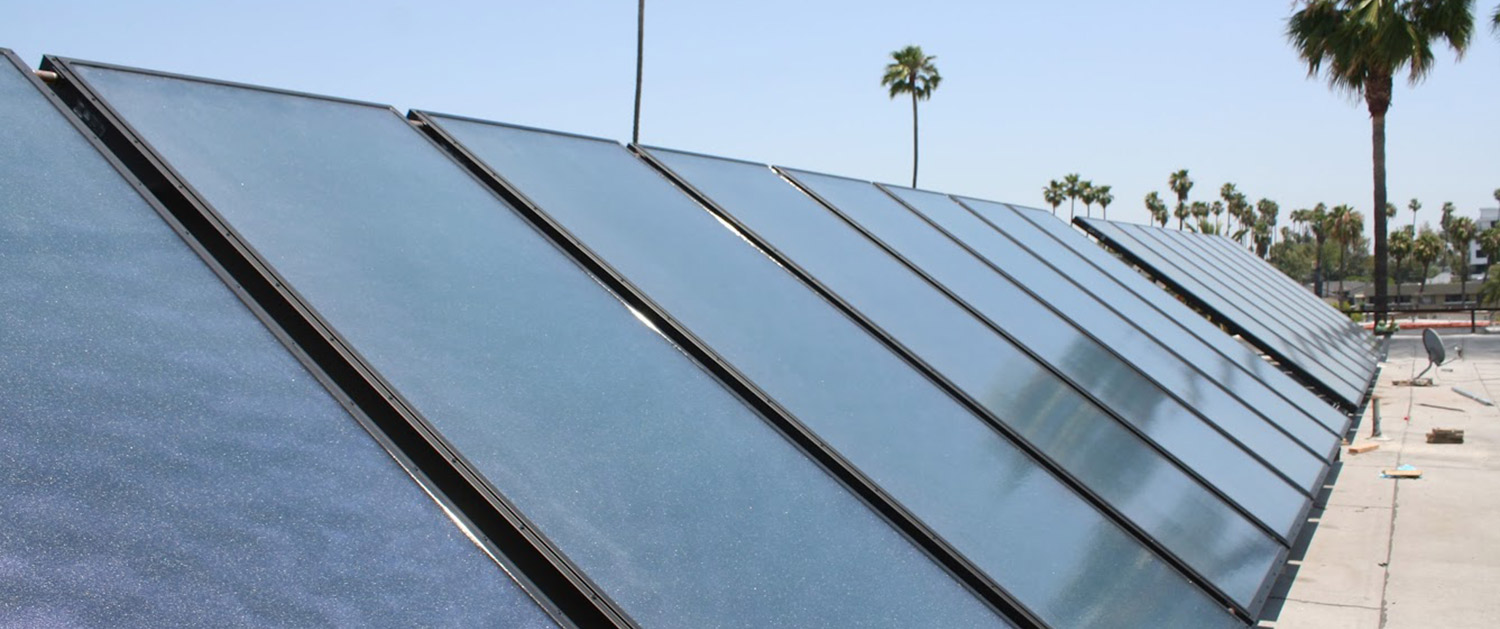

Solar Water Heating Products
Solar Water Heating, in all aspects, across all industries, is energy security. We use the term energy security to refer to a nation's ability to control its supply of energy. Most countries have to buy at least some of the energy that they require. Where a country relies heavily on external supplies of such energy sources, they have low energy security.
Additionally, if we take the term energy security and apply it to a residential property, commercial property, or industrial property, and install a solar water heating system at this property, we are helping to control energy costs, amid rising and uncertain utility costs.
How do Solar Hot Water Systems Work?
A solar hot water system uses solar collectors to capture heat from the sun and transfer that energy into water for later use. How that heat moves through the system depends on the system configuration.
For an active indirect system, when sufficient solar energy is available, a controller activates the circulation pump. Heat-transfer fluid moves through the collector loop and transfers heat to the stored water through a heat exchanger.
The exact sequence varies by system type, control strategy, storage configuration, and backup-heating design.
Direct vs. Indirect Solar Water Heating Systems
The system described above is one example of an indirect closed-loop solar water heating system. In a glycol-based indirect system, heat-transfer fluid circulates through the solar loop and transfers collected heat to the potable water through a heat exchanger.
SunEarth solar water heating configurations include direct/open-loop, indirect glycol, drainback, and passive systems. The appropriate configuration depends on climate, freeze exposure, water quality, hot-water demand, building conditions, and system design.
Tailored Energy Solutions to Fit your Needs
SunEarth offers a variety of solar hot water heating products and solutions.
Request a free consultation, and SunEarth can help identify the collector, storage, controls, circulation equipment, and system configuration appropriate for the project.
Backup Heating, Maintenance, and System Lifespan
Solar water heating systems are commonly designed with auxiliary or backup heating so hot-water demand can continue to be met when available solar energy is insufficient. The specific backup configuration depends on the system design.
Routine maintenance and genuine replacement parts can help keep collectors, pumps, and controls performing for years, and professional installation protects the system from day one.
Frequently Asked Questions
No. Solar water heating systems qualify for the Federal Residential Clean Energy Credit under Section 25D. This credit does not require a Qualified Manufacturer Identification (QMID) or product identification number (QPIN). QMID requirements apply only to certain products under Section 25C, such as windows, insulation, heat pumps, and other energy efficiency equipment. Solar water heating systems are claimed under Part I of IRS Form 5695. Because tax situations vary, homeowners should consult a qualified tax professional regarding their specific filing.
The ROI for our equipment usually takes anywhere between 5 to 12 years. This varies based on the types of fuel being used to heat the water, the type of government approval for your project, and other factors that we are happy to review with you to determine the exact ROI for your solar water heating product.
The short answer to this question is no. Generally speaking, you never have to drain your solar storage tank. There are many different systems with different functionalities, and each of these systems could require a different solution for when the water gets too hot inside the tank. Feel free to contact SunEarth with any of your questions about your specific solar water heating product.
The solar water heater can heat the water up to 180 to 200 degrees Fahrenheit. The mixing station can mix the water to bring it to a safe temperature to use. The water that we use in our house in our faucet and shower is typically around 120 to 125 degrees Fahrenheit.
The main tradeoffs are a higher upfront cost than a standard water heater and, for direct (open-loop) systems, vulnerability to freeze damage in cold climates. SunEarth's indirect (closed-loop) systems address the freeze risk by circulating solar fluid instead of household water through the collector, and the federal tax credit and 5 to 12 year ROI window (see above) offset much of the added cost over time.
Yes. The insulated solar storage tank holds the heat collected during the day, and the system draws on the main water heater automatically whenever solar-heated water isn't hot enough, so hot water is available overnight and on cloudy days without any action on your part.
It depends on your climate. Homes in freeze-prone climates need an indirect (closed-loop) system, since solar fluid rather than household water circulates through the collector. Homes in climates that rarely freeze can use a simpler, lower-cost direct (open-loop) system. SunEarth sizes the collector and storage tank to your household's hot water demand before recommending either system.
Yes, with the right system for your climate. SunEarth's indirect systems circulate solar fluid, not water, through the collector, so the system keeps operating and resists freeze damage through winter, and the main water heater automatically covers any gap in sun exposure.