
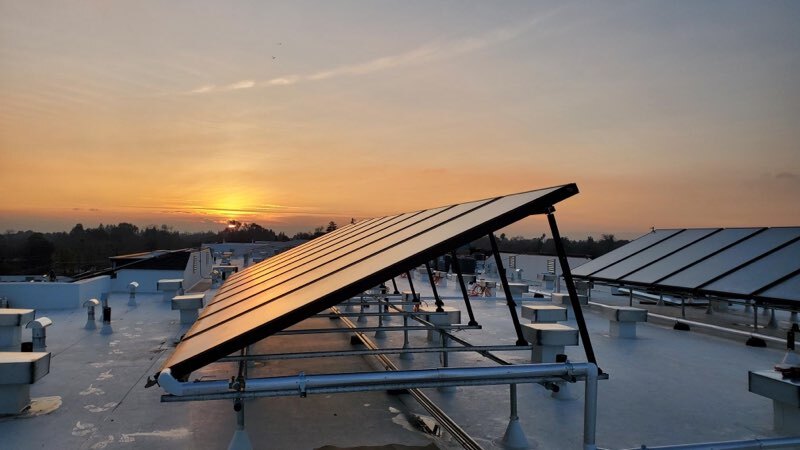
Solar Thermal vs. Heat Pump Water Heaters: A Commercial System Selection Guide
How hot-water demand, operating temperatures, thermal storage, and building infrastructure influence renewable water-heating decisions.
Choosing the Right Commercial Hot-Water Strategy
Commercial buildings rely on hot water for sanitation, cleaning, food service, laundry, bathing, and industrial processes. As building owners and engineers evaluate electrification and renewable energy technologies, two solutions frequently enter the discussion: solar thermal water heating and heat pump water heaters.
Both technologies can reduce dependence on conventional water-heating equipment, but they operate differently. Solar thermal systems capture energy from sunlight and transfer it directly as heat. Heat pump water heaters use electricity to transfer heat from surrounding air or another source into water.
The most effective solution depends on the building's hot-water demand, required temperatures, climate, available space, electrical infrastructure, and long-term operating objectives.
In some applications, combining solar thermal with heat pump water heating offers an additional opportunity to reduce purchased energy while maintaining dependable hot-water delivery.
Commercial Hot-Water Planning Tool
Estimate your building's hot-water heating demand and explore whether solar thermal, heat pumps, or a hybrid system may be worth evaluating.
Estimated Thermal Demand
Preliminary calculation using 8.34 lb/gallon and approximately 1 Btu/lb·°F. Excludes storage, distribution, and system losses. Does not size equipment or predict solar production.
Answer these initial project questions to identify factors that deserve further engineering review.
Educational planning tool only. Results are not an engineering design, equipment recommendation, energy savings forecast, or performance guarantee.
Solar Thermal vs. Heat Pump Water Heaters: Key Differences
Understanding how each technology operates is the first step toward selecting the right commercial hot-water system.
| Design Factor | Solar Thermal | Heat Pump Water Heater |
|---|---|---|
| Energy source | Solar radiation | Electricity and ambient or source heat |
| Primary function | Renewable water heating and preheating | Electrically driven water heating |
| Key operating factors | Solar availability, collector temperature, load profile | Source temperature, water temperature, equipment performance |
| Space requirements | Collector area, piping, and often storage | Equipment space, airflow or source provisions, and potentially storage |
| Thermal storage | Often used to match solar collection with demand | Can support peak demand and load shifting |
| Auxiliary heating | Commonly included | May be required depending on system design |
| Primary design challenge | Matching variable solar output to demand | Meeting recovery and temperature requirements efficiently |
These characteristics are general. Equipment performance, installed costs, and lifecycle economics must be evaluated using project-specific conditions.
When Does Solar Thermal Make Sense for Commercial Hot Water?
Solar thermal is particularly worth evaluating in buildings with substantial and predictable hot-water consumption, available collector space, and opportunities to use renewable heat throughout the year.
Applications may include:
-
Hotels and resorts: Domestic hot water for guest rooms, kitchens, and laundry.
-
Multifamily housing: Centralized hot-water systems serving multiple residences.
-
Healthcare and institutional buildings: Recurring demand for sanitation, bathing, and facility operations.
-
Commercial laundries: High-volume hot-water consumption.
-
Food processing and agriculture: Water heating for cleaning, sanitation, and suitable process applications.
-
Industrial facilities: Renewable preheating for compatible process-water loads.
In a solar preheating configuration, incoming water is heated using solar energy before reaching the primary or auxiliary water-heating equipment.
By increasing the temperature of incoming water, solar thermal can reduce the additional heat that downstream equipment must provide.
Key Solar Thermal Design Considerations
Collector area and solar exposure
Roof or ground space, shading, orientation, and structural capacity influence the amount of solar energy available to a project.
Daily and seasonal hot-water demand
A consistent hot-water load can create opportunities to use collected solar energy throughout the year. Seasonal occupancy and production schedules should also be considered.
Operating temperature
The required water temperature influences collector selection, operating efficiency, and the feasibility of solar preheating.
Thermal storage
Storage helps manage the difference between when solar energy is available and when hot water is needed.
Freeze protection and climate
System configurations must account for local freezing conditions, water quality, and appropriate heat-transfer arrangements.
Existing water-heating infrastructure
Solar preheating may be integrated with existing boilers, water heaters, or other auxiliary heating equipment when the system is appropriately engineered.
When Does a Heat Pump Water Heater Make Sense?
Heat pump water heaters are an important option for commercial buildings pursuing electrification.
Unlike conventional electric resistance heating, heat pumps transfer heat from a source such as outdoor air into the water-heating system.
Under suitable operating conditions, this process can deliver multiple units of thermal energy for each unit of electricity consumed.
However, actual performance varies with source temperature, required water temperature, equipment design, and operating conditions.
Key Heat Pump Design Considerations
Electrical infrastructure
Commercial heat pump installations may require evaluation of electrical service capacity, distribution equipment, and potential upgrades.
Ambient and source temperatures
The available heat source affects system performance, particularly during colder operating conditions.
Hot-water recovery
Equipment must be capable of meeting the building's peak demand and restoring storage temperatures within the required time.
Operating temperature
Higher delivery temperatures may affect equipment selection, performance, and auxiliary heating requirements.
Equipment placement
Airflow, mechanical-room space, noise, and service clearances may influence installation feasibility.
Utility rates
Electricity pricing, demand charges, and time-of-use schedules should be considered when evaluating operating costs.
Can Solar Thermal and Heat Pumps Work Together?
Yes. Solar thermal and heat pump water heaters can serve complementary roles in commercial hot-water systems.
Rather than treating the technologies as competing solutions, engineers can evaluate whether solar thermal preheating reduces the thermal load that a downstream heat pump must handle.
A conceptual hybrid configuration may operate as follows:
-
Cold water enters the solar preheating system.
-
Solar thermal collectors capture available solar energy.
-
Heat is transferred to the water through an appropriate storage or heat-exchange arrangement.
-
Preheated water is supplied to a downstream heat pump or auxiliary heating system.
-
Downstream equipment provides any additional temperature rise required to meet the building's hot-water demand.
Conceptual system flow:
Cold Water → Solar Thermal Preheating and Storage → Heat Pump or Auxiliary Heating → Building Hot-Water Distribution
Actual hydraulic arrangements depend on equipment specifications, system temperatures, recirculation requirements, controls, and applicable codes.
Why Consider a Hybrid Configuration?
A properly engineered hybrid system may offer several advantages:
-
Solar thermal can provide renewable preheating when useful solar energy is available.
-
Heat pumps can provide controlled temperature lift using electricity.
-
Thermal storage can help coordinate energy availability with hot-water demand.
-
Existing water-heating equipment may remain available for auxiliary or backup service.
-
The system can be evaluated as part of a broader building electrification strategy.
These potential advantages must be verified through project-specific design and modeling. Combining technologies does not automatically produce the lowest-cost or highest-performing solution.
Start With the Building's Hot-Water Load
Before selecting equipment, engineers should establish how much hot water the facility uses, when it is needed, and the temperature rise required.
A common preliminary water-heating calculation is:
Thermal Energy (Btu) = Water Volume (Gallons) × 8.34 × Temperature Rise (°F)
Example: Commercial Facility Using 2,000 Gallons per Day
Consider a hypothetical commercial facility with the following operating conditions:
-
Daily hot-water consumption: 2,000 gallons
-
Incoming water temperature: 60°F
-
Required water temperature: 130°F
-
Temperature rise: 70°F
The daily useful water-heating requirement is:
2,000 × 8.34 × 70 = 1,167,600 Btu/day
This represents approximately 342 kWh of thermal energy per day, before accounting for storage, distribution, recirculation, or other system losses.
If a proposed solar thermal system were modeled to provide 30% of that useful daily load:
-
Solar thermal contribution: approximately 350,280 Btu/day
-
Remaining downstream heating requirement: approximately 817,320 Btu/day
The 30% contribution is an illustrative assumption, not a prediction of actual solar thermal performance.
Actual solar contribution depends on collector selection, system configuration, local solar conditions, water temperatures, and the building's demand profile.
This example demonstrates why hot-water demand should be established before comparing collector area, heat pump capacity, storage volume, or equipment costs.
Seven Questions to Ask Before Selecting a Commercial Hot-Water System
Daily consumption alone may not capture the equipment capacity needed during periods of peak use.
Preheating requirements may differ substantially from final delivery temperatures or industrial process requirements.
Roof area, structural conditions, shading, and solar exposure affect solar thermal feasibility.
Available electrical capacity and potential service upgrades can materially affect project scope.
Retaining suitable boilers, water heaters, or storage equipment may influence retrofit economics.
Storage can help manage demand peaks, solar availability, and heat pump operating schedules.
Installed cost, annual purchased energy, maintenance, incentives, emissions, and lifecycle economics should be evaluated consistently.
Compare Annual System Performance, Not Just Equipment Ratings
Solar thermal collectors and heat pump water heaters are evaluated using different performance metrics.
Solar thermal collector performance depends on solar irradiance, operating temperature, ambient conditions, and collector design.
Heat pump performance is commonly expressed through the coefficient of performance (COP), which varies with source conditions and the required water temperature.
A solar collector efficiency percentage and a heat pump COP are not directly interchangeable measures of whole-system performance.
A meaningful commercial system comparison should evaluate:
-
Annual useful thermal energy delivered
-
Purchased electricity and fuel consumption
-
Peak electrical demand
-
Auxiliary heating requirements
-
Thermal storage and distribution losses
-
Installed equipment and infrastructure costs
-
Maintenance and replacement assumptions
-
Available incentives
-
Lifecycle operating costs
-
Greenhouse gas emissions under appropriate energy-source assumptions
Comparisons should use consistent load profiles, climate conditions, and economic assumptions.
Where SunEarth Fits Into Commercial Hot-Water Design
SunEarth manufactures solar thermal equipment for residential, commercial, and industrial water-heating applications.
For commercial projects, solar thermal may serve as a dedicated renewable heating source or as a preheating component integrated with other equipment.
Depending on the application and approved system design, relevant SunEarth technologies include:
Solar Thermal Collectors
SunEarth's ThermoRay and Empire collector families support solar heat collection for appropriately designed water-heating systems.
Thermal Storage
Storage solutions help accommodate project-specific volume, temperature, and integration requirements.
Pumping and Circulation
SunEarth SolarStation equipment supports circulation in suitable solar thermal configurations.
Monitoring and Controls
SolFlux controls may support compatible system monitoring and operation, subject to equipment and application requirements.
Technical Design Resources
SunEarth provides engineering documentation, specifications, CAD and Revit resources, and product information to assist with system evaluation.
Solar thermal can be considered alongside heat pumps, boilers, and existing heating equipment as part of a coordinated commercial hot-water strategy.
Frequently Asked Questions
Neither technology is universally better. Solar thermal uses sunlight to generate useful heat, while heat pumps use electricity to transfer heat. The appropriate solution depends on hot-water demand, operating temperatures, climate, infrastructure, and project economics.
Solar preheating can reduce the temperature rise required from downstream equipment when useful solar energy is available. The effect on electricity consumption depends on the integrated system's design, controls, and operating conditions.
Commercial solar thermal systems commonly include auxiliary heating to maintain reliable hot-water delivery when solar energy is insufficient.
In many cases, solar preheating can be evaluated as an addition to existing equipment. Feasibility depends on available space, hydraulic arrangements, operating temperatures, equipment condition, and applicable codes.
Storage requirements depend on the building's hot-water demand, collector configuration, expected solar production, operating temperatures, and control strategy. Proper sizing requires project-specific calculations.
Yes. Solar thermal can be evaluated as a renewable heat source alongside electrically driven equipment, including heat pumps. It may reduce the downstream heating requirement when useful solar energy is available.
Operating costs depend on annual useful energy delivery, purchased electricity and fuel, utility rates, system losses, maintenance, and the specific equipment configuration. A project-specific lifecycle analysis is needed to compare alternatives.
Plan Your Commercial Hot-Water Project
Selecting the right commercial water-heating strategy begins with understanding the building's thermal demand, infrastructure, and operating requirements.
Whether the project involves a new commercial building, a multifamily retrofit, a central hot-water plant, or an industrial process application, SunEarth can help evaluate where solar thermal collection, storage, and system integration may fit.
Explore SunEarth Design Resources
Discuss Your Commercial Project
Engineering Note: This guide provides preliminary system-selection information. Final equipment selection, hydraulic design, controls, code compliance, and performance estimates should be reviewed by qualified design professionals using current manufacturer documentation and project-specific conditions.