
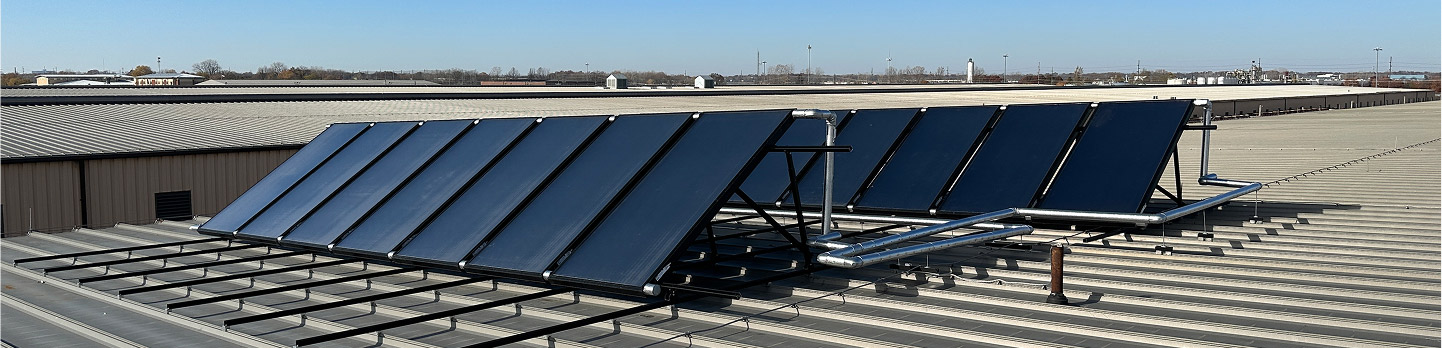
Why Mounting Systems Matter
Solar thermal systems are engineered for longevity, often delivering decades of reliable performance when properly designed and installed. While collectors and system components receive much of the attention, long-term performance is equally dependent on how the system is mounted and integrated into the building envelope.
Mounting is not just a structural consideration. It is a performance factor.
A properly designed mounting system supports:
- Structural integrity under wind and environmental loads
- Protection against water intrusion
- Consistent thermal performance over time
- Long-term system durability with minimal maintenance
When these elements are aligned, the system performs as intended. When they are overlooked, performance can be compromised, not because of the technology, but because of the installation approach.
The Role of Mounting in System Performance
Solar thermal collectors are exposed to continuous environmental stress:
- Wind uplift and lateral loads
- Thermal expansion and contraction
- UV exposure and weather cycling
- Moisture and coastal conditions
Mounting systems must account for all of these variables while maintaining a secure, watertight connection to the structure.
This is especially critical in roof-mounted applications, where penetrations must be properly sealed and structurally anchored. The mounting system becomes the interface between the solar installation and the building itself.
A well-executed mounting strategy ensures that:
- Loads are transferred safely to structural members
- Roof integrity is preserved
- System alignment and spacing are maintained
- Performance remains consistent over time
Watertight Integration with the Building Envelope
Roof penetrations are one of the most sensitive aspects of any installation.
Proper mounting design focuses on:
- Minimizing penetration points
- Creating redundant sealing layers
- Ensuring compatibility with roofing materials
- Maintaining long-term adhesion and protection
Water intrusion is not an immediate issue, it is a long-term risk. Systems that prioritize watertight integration from the outset protect both the building and the solar installation over time.
Structural Anchoring and Load Management
Collectors must remain securely anchored under a range of conditions, including high wind exposure and dynamic loading.
Key considerations include:
- Direct attachment to rafters or structural members
- Use of corrosion-resistant fasteners
- Proper spacing and distribution of mounting points
- Compliance with local structural and wind load requirements
Mounting systems that are engineered with these factors in mind provide confidence not only during installation, but throughout the life of the system.
Thermal Performance Starts with Proper Spacing
Mounting design also impacts thermal performance.
Proper elevation and spacing between the collector and the roof surface allows for:
- Improved system efficiency
- Reduced material stress over time
These details may seem small, but they contribute directly to the system’s ability to operate at peak performance.
Consistency Across Installations
Inconsistent installation practices can lead to variability in system performance.
Standardized mounting solutions help ensure:
- Repeatable installation quality
- Reduced installation time and complexity
- Alignment with manufacturer specifications
- Long-term system reliability
For contractors, this means fewer variables in the field. For system owners, it means consistent results.
Designed for Real-World Conditions
Solar thermal systems are installed in a wide range of environments, including:
- Coastal regions with salt exposure
- High-wind areas
- Regions with significant temperature variation
Mounting systems must be designed to perform across these conditions, maintaining both structural integrity and weather resistance over time.
Durability is not a feature, it is a requirement.
A System-Level Perspective
Solar thermal performance is not defined by a single component. It is the result of how the entire system works together.
Collectors, controls, storage, and mounting all play a role.
Mounting systems, in particular, provide the foundation that supports everything else. When designed and installed correctly, they enable the system to deliver the performance it was engineered to achieve.
Protecting long-term performance starts at the roofline and it starts with how the system is mounted.