
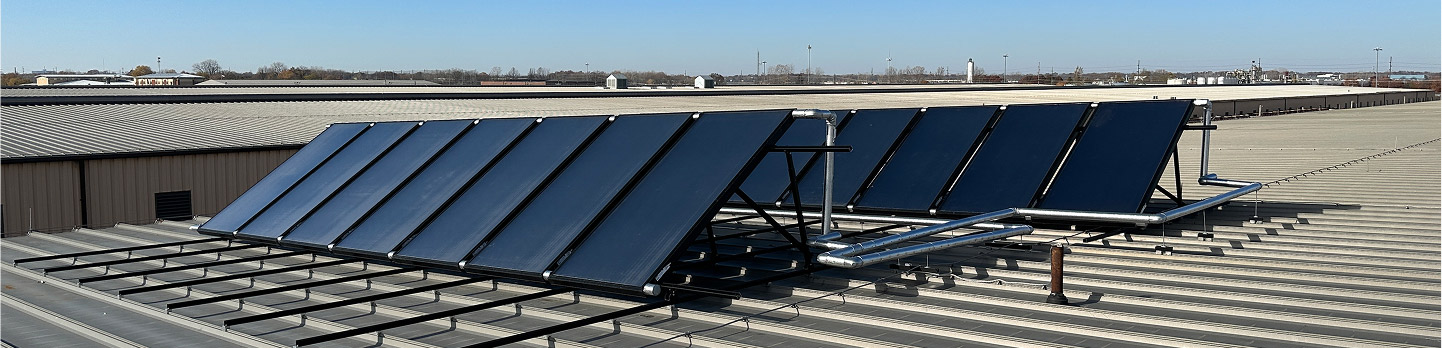
Why Commercial Buildings Need Separate Strategies for Heat and Electricity
Electricity demand is rising across the United States.
Data centers, artificial intelligence, building electrification, electric vehicles, cooling demand, manufacturing growth, and new commercial loads are all placing additional pressure on the electric grid. The U.S. Energy Information Administration’s July 2026 Short-Term Energy Outlook was released July 7, and the broader trend is clear: electricity planning is becoming a larger strategic issue for building owners, engineers, utilities, and facility managers.
Recent grid activity reinforces that point. In July, PJM Interconnection, the largest U.S. grid operator, moved forward with plans to address widening electricity shortages connected in part to data center growth, while the U.S. Department of Energy issued an emergency order to support the western grid during heat-related stress conditions.
For commercial buildings, this raises an important question:
Should every energy load be planned as an electrical load?
The answer is no.
Commercial buildings need separate strategies for electricity and heat.
That distinction matters because buildings do not consume energy in one single form. They use electricity for lighting, ventilation, refrigeration, controls, computing, plug loads, and many mechanical systems. They also require thermal energy for space heating, domestic hot water, laundry, kitchens, pools, sanitation, and process heat.
When building owners treat every decarbonization challenge as an electrification challenge, they may overlook one of the most practical opportunities available: reducing thermal energy use directly.
That is where commercial solar thermal belongs in the conversation.
Why heat and electricity should be planned separately
Electricity and heat solve different building needs.
Electricity powers equipment.
Heat provides temperature.
In many commercial buildings, hot water is not an optional load. Hotels need it for guest rooms, laundries, kitchens, pools, and spas. Healthcare facilities need it for sanitation, cleaning, food service, laundry, and patient care. Multifamily properties need it every day for residents. Restaurants, athletic facilities, schools, car washes, and industrial buildings may all have recurring thermal loads that directly affect operating costs.
The U.S. Energy Information Administration reports that the United States had approximately 5.9 million commercial buildings totaling about 96.4 billion square feet of floorspace in 2018. Those buildings consumed about 6.8 quadrillion Btu of energy. Electricity accounted for 60% of total commercial building energy use, while natural gas accounted for 34%. EIA also notes that natural gas is generally used directly in commercial buildings to heat water and interior space and to operate cooking and cooling equipment.
That means commercial building energy planning is not just an electrical question.
It is also a thermal question.
And in some applications, the most efficient decarbonization pathway may not be to convert every thermal load into a new electrical load. It may be to reduce the thermal load directly with renewable heat.
Domestic hot water deserves its own decarbonization strategy
Domestic hot water is often hidden inside the mechanical room, but it can be one of the most important energy loads in a commercial building.
The U.S. Department of Energy has noted that commercial water-heating energy use is concentrated in building types with large hot water requirements, including restaurants, laundries, hotels, and hospitals.
That concentration is important.
It means solar thermal does not need to be relevant for every building to be highly valuable. It needs to be matched to the right applications.
Commercial solar water heating is especially relevant for buildings with:
- consistent daily hot water demand,
- significant natural gas, propane, or electric water-heating costs,
- long operating hours,
- available roof or ground-mount area,
- sustainability or decarbonization goals,
- interest in reducing long-term operating costs,
- limited electrical capacity for future upgrades.
For these buildings, domestic hot water should be evaluated independently from lighting, HVAC, plug loads, and other electrical systems.
That is the foundation of smarter energy planning.
Electrification is important - but it is not the entire strategy
Electrification will continue to play a major role in building decarbonization.
Heat pumps, electric HVAC systems, electric vehicles, battery storage, advanced controls, and renewable electricity are all reshaping the built environment. But electrification does not eliminate the need for careful load planning.
Every new electric system has to be powered.
As commercial buildings add electric equipment, owners and engineers may need to evaluate electrical service capacity, transformer limitations, distribution panels, utility infrastructure, peak demand, backup power, and future expansion plans.
That does not mean electrification is wrong.
It means electrification should be applied intelligently.
The better question is not:
“Can this building electrify everything?”
The better question is:
“Which building loads should be electrified, which loads can be reduced, and which technologies are best suited to each application?”
For hot water-intensive commercial buildings, solar thermal gives project teams another option.
It can reduce conventional water-heating energy use without turning the entire hot water load into another electrical burden.
What solar thermal does differently
Solar photovoltaic systems convert sunlight into electricity.
Solar thermal systems convert sunlight into usable heat.
That distinction is simple, but it is often overlooked.
When the building need is electricity, PV can be an excellent solution.
When the building need is heat, solar thermal can address the load directly.
The National Renewable Energy Laboratory describes solar heat as a resource that can generate heated fluid or steam for commercial and industrial use, with applications including building and water heating, district heating, pool heating, industrial process heat, and other thermal uses.
For commercial water heating, solar thermal collectors capture heat from the sun and transfer that energy into the building’s water-heating system. Supplemental or backup equipment continues to provide reliable hot water when solar energy is not available or when demand exceeds solar production.
The goal is not necessarily to eliminate all conventional energy use.
The goal is to reduce the amount of conventional energy the building must purchase and consume.
Why this matters more as electricity demand grows
The electric grid is entering a more complicated era.
Electricity demand is rising. Peak demand events are becoming more visible. Data centers and large commercial loads are changing utility planning. Extreme weather can create additional pressure. Recent reporting on PJM and the Southwest Power Pool shows how grid operators are actively planning for shortfalls, emergency conditions, and high-demand periods.
For commercial buildings, this creates both risk and opportunity.
The risk is that future projects may become more expensive or more complex if every decarbonization measure increases electrical demand.
The opportunity is that building owners can become more strategic.
They can ask:
- Where do we truly need electricity?
- Where can energy use be reduced first?
- Which loads are thermal rather than electrical?
- Which systems can lower operating costs without increasing peak electrical demand?
- Can renewable heat help reduce the burden on the electrical system?
These questions are especially relevant for engineers, plumbing designers, facility managers, and sustainability teams preparing for projects over the next several years.
Commercial solar thermal and plumbing engineers
This conversation is especially relevant to the plumbing engineering community.
At the 2026 ASPE Convention & Expo in Oklahoma City, plumbing engineers, designers, master plumbers, code officials, and industry professionals will gather to discuss sustainable design, industry innovation, best practices, compliance, and emerging trends. ASPE lists the 2026 Convention for October 8–14, with the Expo taking place October 12–13.
For this audience, commercial solar water heating is not just a sustainability feature.
It is a mechanical system design strategy.
It touches:
- domestic hot water demand,
- storage capacity,
- recirculation,
- controls,
- pumps,
- backup heating,
- commissioning,
- long-term maintenance,
- lifecycle energy costs.
That makes solar thermal highly relevant to plumbing system design professionals.
When domestic hot water demand is significant, renewable heat should be considered during early project planning - not added as an afterthought.
Commercial solar thermal and renewable thermal leadership
The Renewable Thermal Collaborative Summit will bring together leaders across the renewable thermal energy landscape to discuss strategies for decarbonizing thermal energy use. The 2026 RTC Summit is scheduled for October 21–23 in Arlington, Virginia, near Washington, D.C.
That matters because thermal energy is increasingly being recognized as its own decarbonization category.
For years, many building energy conversations have centered on electricity generation. But commercial and industrial facilities also need practical solutions for heat.
Renewable thermal strategies can include solar thermal, thermal storage, heat pumps, renewable fuels, geothermal, waste heat recovery, and hybrid systems.
The key is matching the technology to the load.
For SunEarth, this is where commercial solar thermal has a clear role: proven renewable heat for buildings with significant hot water demand.
Commercial solar thermal and the HVACR market
The AHR Expo 2027 in Chicago will bring together HVACR professionals, engineers, contractors, OEMs, design-build professionals, wholesalers, distributors, architects, facility managers, public utility professionals, educators, and others across commercial, industrial, institutional, and residential markets. AHR Expo lists the 2027 event for January 25–27 at McCormick Place in Chicago.
This audience is already thinking about electrification, controls, heat pumps, decarbonization, refrigerants, energy efficiency, and building performance.
That makes AHR a natural place to raise a practical question:
If a building needs heat, should electricity always be the first tool we reach for?
Solar thermal gives HVACR and mechanical professionals a way to discuss renewable heat as part of a broader building energy strategy.
Not anti-electrification.
Not anti-PV.
Not anti-heat pump.
Just smarter load matching.
The case for separate strategies
A commercial building energy strategy should identify electrical loads and thermal loads separately.
Electrical loads may include:
- lighting,
- plug loads,
- controls,
- refrigeration,
- ventilation,
- cooling,
- computing,
- electric vehicle charging,
- electric mechanical systems.
Thermal loads may include:
- domestic hot water,
- commercial laundry,
- kitchens,
- pools and spas,
- sanitation,
- space heating,
- low-temperature process heat,
- industrial hot water.
Once these loads are separated, the design team can evaluate the best solution for each.
Some loads may be best served by efficient electric equipment.
Some may be reduced through controls or conservation.
Some may benefit from storage.
Some may be well suited for renewable heat.
For buildings with large hot water loads, solar thermal should be part of that evaluation.
Where solar thermal can deliver the greatest value
Solar thermal is strongest when the building has meaningful, recurring hot water demand.
Good-fit applications often include:
· Hotels and resorts
o Guest rooms, laundries, pools, spas, and kitchens can create consistent hot water demand.
· Multifamily housing
o Apartments, affordable housing, student housing, and senior living communities often have centralized domestic hot water needs.
· Healthcare facilities
o Hospitals and care facilities use hot water for sanitation, laundry, food service, and patient needs.
· Commercial laundry
o Laundry operations can create predictable, energy-intensive thermal loads.
· Food service and commercial kitchens
o Restaurants, cafeterias, and institutional kitchens use hot water for cleaning, sanitation, and food preparation.
· Car washes
o Car wash facilities may use significant heated water during operating hours.
· Schools and universities
o Campuses may have dormitories, dining halls, locker rooms, pools, and other hot water loads.
· Industrial and process-water applications
o Some facilities require low-temperature or moderate-temperature process heat that may be evaluated for renewable thermal support.
The best projects are site-specific. Solar thermal feasibility depends on hot water demand, climate, available installation area, utility costs, system configuration, storage strategy, operating schedule, and project goals.
A practical path forward
Commercial decarbonization does not need to be framed as a choice between electrification and renewable heat.
The strongest strategies often use both.
A building may use PV to generate electricity, heat pumps for certain mechanical loads, controls to reduce waste, storage to improve flexibility, and solar thermal to reduce the energy required for domestic hot water.
The future of building energy is not one technology.
It is better planning.
For commercial buildings, that starts with a simple but powerful distinction:
Electricity and heat are different energy needs.
When project teams recognize that distinction, they can design buildings that reduce operating costs, lower emissions, preserve electrical capacity, and use each technology where it delivers the greatest value.
For buildings with significant hot water demand, solar thermal remains a proven, practical, and highly relevant part of that strategy.
Visit SunEarth This Fall and Winter
SunEarth is continuing the conversation around commercial solar thermal, renewable heat, and smarter building energy planning at upcoming industry events.
ASPE Convention & Expo 2026
Oklahoma City, Oklahoma
Convention: October 8–14, 2026
Expo: October 12–13, 2026
Schedule a meeting with SunEarth to discuss your next commercial solar water heating project.
RTC Summit 2026
Arlington, Virginia
October 21–23, 2026
AHR Expo 2027
McCormick Place, Chicago
January 25–27, 2027
If your project includes domestic hot water, process hot water, thermal storage, or commercial decarbonization goals, SunEarth can help evaluate where solar thermal fits.