
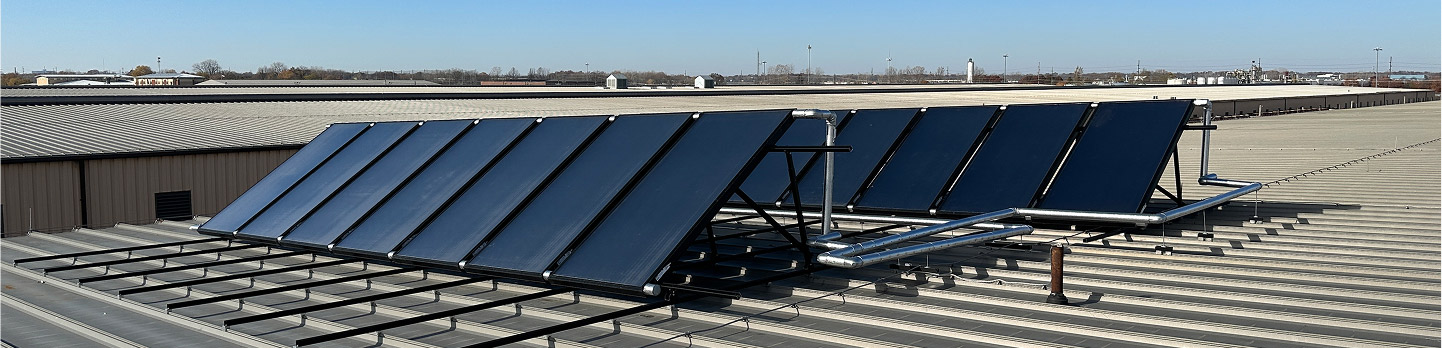
What Plumbing Engineers Should Know About Renewable Heat
Commercial hot water design is changing.
Project teams are being asked to manage operating costs, support energy-performance goals, evaluate decarbonization strategies, and design systems that remain reliable over time.
For plumbing engineers, that means domestic hot water can no longer be treated as a simple equipment-sizing exercise.
It is a system strategy.
And in buildings with significant hot water demand, renewable heat deserves a place in that conversation.
As SunEarth joins engineers, designers, contractors, manufacturers, and industry professionals at the 2026 ASPE Convention & Expo in Oklahoma City, this is one of the key conversations we are bringing forward: commercial buildings do not only need power. They need heat. And for the right applications, some of that heat can be renewable.
Renewable heat starts with the domestic hot water load
Renewable heat is not an abstract sustainability concept.
In commercial plumbing design, it starts with a practical question:
How much hot water does the building need, and when does it need it?
Hotels, multifamily buildings, healthcare facilities, laundries, restaurants, schools, pools, car washes, and process-water applications can all have meaningful thermal demand. In these buildings, domestic hot water is tied directly to daily operations, comfort, sanitation, production, or service delivery.
That matters because solar thermal is strongest when there is a recurring need for heat.
The opportunity is not simply to add solar equipment.
The opportunity is to reduce the amount of conventional energy required to meet a real hot water load.
For plumbing engineers, this means renewable heat should be evaluated in relation to:
- daily hot water volume,
- peak demand timing,
- delivery temperature,
- storage requirements,
- backup equipment,
- available collector space,
- piping and mechanical-room coordination,
- controls and monitoring,
- commissioning,
- long-term maintenance.
The load defines the opportunity.
Solar thermal is a preheat and integration strategy
One of the most important distinctions for commercial solar thermal is that it does not need to replace the entire water-heating system.
In many commercial applications, solar thermal works as a renewable preheat strategy.
Collectors capture solar energy and convert it into heat. That heat is transferred into the building’s water-heating system, reducing the amount of conventional energy needed to bring water to final delivery temperature.
Backup equipment still plays an important role.
That is not a weakness.
It is part of a reliable commercial hot water strategy.
For engineers, the question is not:
Can solar thermal meet every condition by itself?
The better question is:
Can renewable heat reduce the conventional energy required to meet this building’s hot water load?
That framing makes solar thermal easier to evaluate and easier to integrate.
Storage matters as much as collection
Collectors may be the most visible part of a solar thermal system, but storage is what helps renewable heat become useful on the building’s schedule.
Solar availability and building demand do not always happen at the same time.
A hotel may experience morning and evening demand peaks. A laundry may use hot water during production hours. A restaurant may need hot water around prep, service, and cleanup. A healthcare facility may require more continuous availability.
Storage helps bridge the gap between when solar heat is captured and when the building needs to use it.
For plumbing engineers, storage evaluation should consider:
- daily demand profile,
- peak periods,
- recovery requirements,
- mechanical-room space,
- temperature strategy,
- backup integration,
- mixing,
- controls,
- service access,
- commissioning.
A well-designed solar thermal system is not just about how much heat can be collected.
It is about whether that heat can be stored, controlled, and delivered in a way that supports the building’s actual operation.
Backup equipment remains part of the design
Commercial buildings need reliable hot water.
Solar thermal systems are typically designed to reduce conventional energy use, while backup equipment ensures final delivery requirements are met when solar contribution is not available or not enough.
This matters for engineers because renewable heat should be integrated into the full domestic hot water strategy, not treated as a separate rooftop add-on.
Backup equipment may still provide:
- final temperature delivery,
- peak-demand support,
- low-solar-period support,
- redundancy,
- operational reliability,
- code and sanitation support.
The goal is not to remove reliability from the system.
The goal is to reduce how much conventional energy the building needs to use before backup equipment completes the work.
That is where renewable heat can create value.
Controls make renewable heat easier to understand
A commercial solar thermal system should not operate like a black box.
Controls help project teams and facility staff understand what the system is doing.
They can support visibility into temperatures, pump operation, storage conditions, system status, operating logic, troubleshooting needs, and long-term performance.
For plumbing engineers, controls matter because they help connect design intent to daily operation.
A system can be designed well, installed well, and still lose value if the people responsible for the building cannot understand or support it over time.
Modern controls, including SunEarth’s SolFlux intelligent controller, help make solar thermal systems easier to see, operate, maintain, and recommission when needed.
Visibility supports confidence.
And confidence supports long-term use.
Existing systems may deserve recommissioning review
Not every renewable heat opportunity begins with a new system.
Some buildings already have solar thermal infrastructure on-site. Collectors may still be on the roof. Storage may still be in the mechanical room. Pumps, piping, valves, controls, and heat exchangers may still exist.
But the system may be offline, underperforming, undocumented, or no longer understood by the current facility team.
Before that infrastructure is written off, it may deserve a recommissioning review.
SunEarth’s recommissioning work at Hyatt Regency Scottsdale Resort & Spa at Gainey Ranch is a strong example of this opportunity. The project showed that existing commercial solar thermal infrastructure can sometimes be evaluated, modernized, and returned to service as part of a renewed hot water strategy.
For plumbing engineers and facility teams, recommissioning creates another path forward:
- evaluate the existing system,
- identify what still has value,
- modernize controls or components where needed,
- verify operation,
- restore renewable heat to productive use.
Existing systems are not automatically sunk costs.
They may be renewable heat assets waiting for a better question.
Renewable heat belongs in system-level design
For plumbing engineers, the renewable heat conversation is not only about collectors.
It is about the full system.
That includes:
- domestic hot water demand,
- storage,
- pump stations,
- heat transfer,
- controls,
- backup equipment,
- piping,
- valves,
- sensors,
- commissioning,
- maintenance access,
- facility-team support.
When these elements are considered together, solar thermal can be evaluated more clearly.
The question becomes less about whether a building “should have solar” and more about whether renewable heat fits the building’s actual hot water strategy.
That is the conversation that matters.
The takeaway
Renewable heat is practical when it is tied to a real thermal load.
For plumbing engineers, that means commercial solar thermal should be evaluated through the lens of domestic hot water design, storage, controls, backup integration, commissioning, and long-term operation.
It is not a replacement for every technology.
It is not the answer for every building.
But for commercial properties with meaningful hot water demand, solar thermal can reduce conventional water-heating energy use and support a more complete energy strategy.
The strongest projects start with the load.
Then the system is designed around it.
Meet SunEarth at ASPE
SunEarth is bringing the renewable heat conversation to the 2026 ASPE Convention & Expo in Oklahoma City.
If you are evaluating domestic hot water, commercial solar thermal, renewable preheat, retrofit integration, SolFlux controls, or recommissioning opportunities, connect with SunEarth during the show.
Let’s talk about where renewable heat fits into your next commercial hot water project.