
Solar Doesn’t Have to Make Electricity: Why Renewable Heat Matters
The U.S. Department of Energy is highlighting how solar thermal technologies can convert sunlight directly into useful heat for applications ranging from food production to high-temperature industrial processes.
Read: DOE — Solar-Thermal Power and Industrial Processes Basics
When most people hear the word solar, they picture photovoltaic panels generating electricity.
But electricity is only one way to put the sun’s energy to work.
The U.S. Department of Energy is highlighting another important role for solar energy: producing useful heat.
In newly published coverage of solar thermal technologies and industrial processes, DOE points to the enormous role heat plays throughout the economy. From food production and manufacturing to processes that depend on hot water and thermal energy, much of the energy we use isn’t ultimately needed as electricity. It’s needed as heat.
That distinction matters.
Solar Energy Can Be Thermal Energy
Solar photovoltaic systems convert sunlight into electricity.
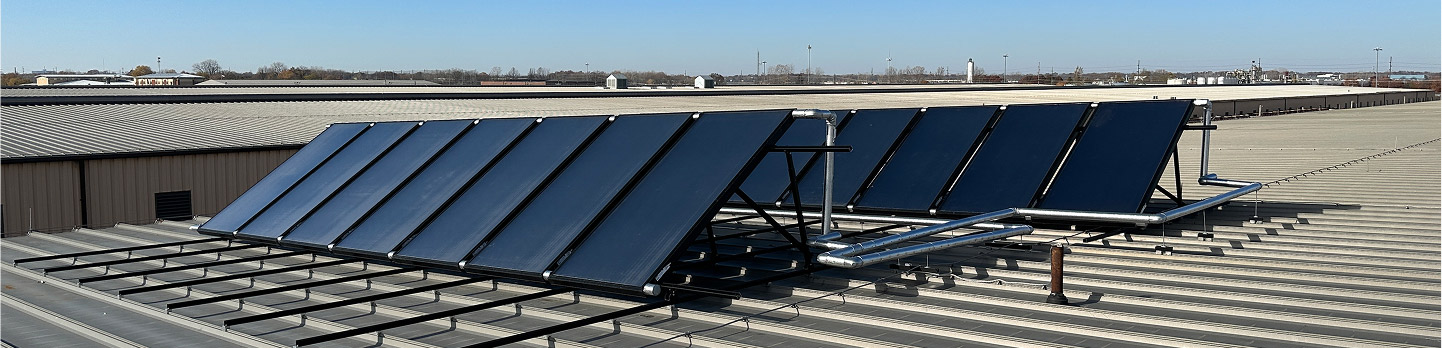
Solar thermal systems capture solar energy as heat.
DOE’s latest coverage focuses primarily on concentrating solar-thermal power technologies capable of producing the high temperatures required for industrial processes. Depending on the technology, these systems can provide heat for applications ranging from food production to chemical processing and manufacturing.
The temperatures and technologies may vary significantly from one application to another, but the underlying principle is remarkably simple:
If the energy you need is heat, solar energy can be used to produce heat directly.
That same principle is at the heart of solar water heating.
When the Load Is Hot Water, Start With the Load
Buildings don’t only consume electricity.
Hotels need hot water. Apartment communities need hot water. Hospitals, universities, recreation facilities and other commercial buildings can have significant and recurring hot-water demand.
That demand is a thermal load.
Rather than beginning with a particular energy technology, commercial hot-water design should begin by understanding that load:
How much hot water does the building use? When does it use it? How is that water currently heated? How much energy is required to meet the demand? And what combination of technologies makes sense for the application?
Solar thermal can then be evaluated as one component of the overall hot-water strategy.
Solar Doesn’t Have to Compete With Electrification
Recognizing heat as its own energy requirement also changes the conversation around electrification.
Solar thermal does not have to be positioned as an alternative to every other energy technology.
A commercial hot-water system can incorporate solar thermal alongside conventional backup heating, heat-pump water heating and other technologies when the application supports it.
The question isn’t necessarily:
Which technology wins?
A better question is:
What does the building need, and what is the most appropriate way to provide it?
For buildings with substantial hot-water demand, renewable thermal energy deserves to be part of that evaluation.
Heat Can Be Stored, Too
There is another important difference in how we think about thermal energy: heat can be stored.
Solar water-heating systems collect energy when solar resources are available and can store that energy as hot water until the building needs it.
DOE describes thermal energy storage broadly as storing heat for later use and notes its role in allowing solar thermal energy to be used at a different time from when it was collected.
For commercial hot-water applications, that introduces a remarkably straightforward concept:
Hot water is stored energy.
The building’s hot-water demand and the availability of sunlight do not have to occur at exactly the same moment.
A Different Way to Think About Solar
DOE’s renewed attention to solar thermal and industrial heat is an important reminder that the energy transition involves more than generating renewable electricity.
It also requires understanding how energy is actually being used.
Sometimes the load is electrical.
Sometimes the load is thermal.
And sometimes the most direct use of solar energy is simply to capture the sun’s heat and put it to work.
For nearly five decades, SunEarth has focused on doing exactly that, designing and manufacturing solar thermal equipment for hot-water applications across commercial, residential and institutional markets.
As buildings reconsider how they generate, store and manage energy, understanding the difference between an electrical load and a thermal load is an increasingly important place to start.
Solar is an energy source. Electricity is one way to use it. Heat is another.
Is solar thermal right for your commercial hot-water application?
Explore SunEarth commercial solar water-heating solutions and design resources, or connect with our team to start with your building’s hot-water load.