
Manufacturing Day 2026 | Renewable Heat. Made Here. | SunEarth
Celebrating Manufacturing Day 2026
Every solar thermal system starts long before a collector reaches a roof.
It starts with materials.
With equipment.
With engineering.
And most importantly, with people who know how to turn those things into a product designed to perform for years.
On October 2, manufacturers across the country are celebrating Manufacturing Day 2026, an annual opportunity to open a window into modern manufacturing and recognize the people, skills and careers behind the products Americans use every day.
At SunEarth, it's also an opportunity to recognize something we've been doing for nearly five decades:
Manufacturing renewable heat here in America.
From Raw Materials to Renewable Heat
SunEarth was founded in California in 1978, with the Empire Collector beginning the company's line of solar hot-water collectors that same year.
Since then, the products, equipment and manufacturing processes have evolved considerably.
But manufacturing solar thermal equipment remains a physical process.
Copper becomes an absorber.
Headers and risers are assembled.
Absorber plates are fabricated.
Frames are built.
Glass, insulation and components come together.
Collectors are assembled and prepared to leave the factory.
And eventually, something that began as raw material in a manufacturing facility becomes part of a system producing useful renewable heat on a building.
That's manufacturing.
And there's a person behind every step.
Nearly Five Decades of Making Things
There's a tendency to talk about renewable energy almost entirely in terms of technology.
Efficiency.
Performance.
Energy savings.
Decarbonization.
Those things matter.
But technology still has to be made.
SunEarth's manufacturing history stretches back to the earliest years of the modern U.S. solar thermal industry. Over the decades, the company has incorporated new products, processes and manufacturing technologies as the industry itself has evolved.
Today, SunEarth operates from its Fontana, California property, where a facility constructed specifically for solar-product manufacturing became the company's home in 2003.
Inside that facility, manufacturing is where engineering becomes something tangible.
Manufacturing Is Also Knowledge
A manufacturing operation isn't simply the equipment inside a building.
It's the knowledge accumulated around it.
It's knowing how materials behave.
It's understanding tolerances and processes.
It's recognizing when something doesn't look right.
It's solving problems on the production floor.
It's improving the way something gets built.
And it's passing that knowledge from one employee to another.
That's one reason Manufacturing Day matters.
The national MFG Day initiative isn't simply about celebrating products made in America. Its larger mission is to show students, educators and communities what manufacturing looks like today and help develop the skilled workforce that will carry American manufacturing forward.
For manufacturers with decades of history, that next generation matters enormously.
Made by Employee Owners
At SunEarth, there's another dimension to that story.
In 2014, The Solaray Corporation, SunEarth's parent company, became a 100% employee-owned company.
That means the people manufacturing, engineering, supporting, selling and shipping these products aren't simply employees of the business.
They're owners of it.
And manufacturing creates a particularly tangible connection between those two ideas.
At the beginning of the process are materials and components.
At the end is something an employee owner can point to and say:
We made that.
What We Make Matters
SunEarth doesn't manufacture solar collectors simply for the sake of making another piece of equipment.
Those collectors have a job to do.
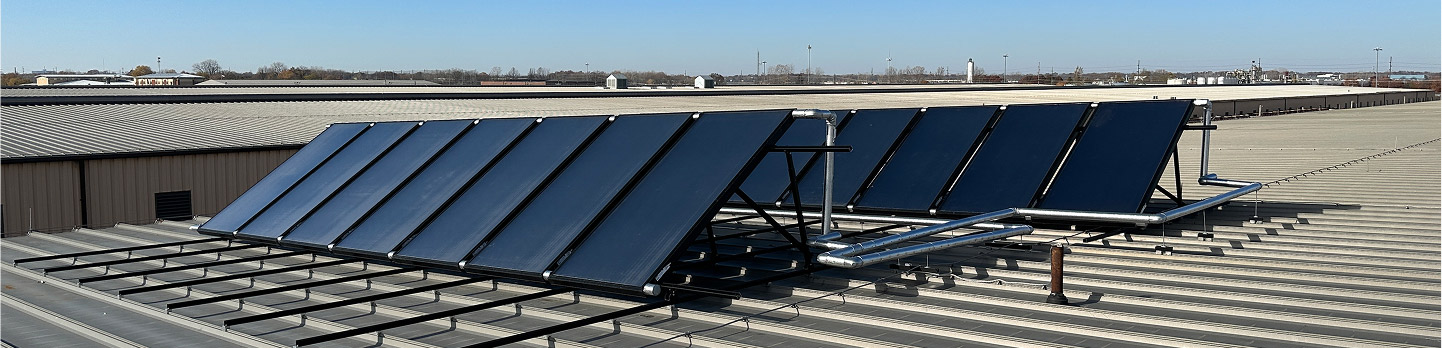
They capture solar energy as heat.
That heat can become hot water for an apartment building, hotel, healthcare facility, university, recreation facility, home or another building with a thermal load.
It can reduce the amount of energy another heating source has to provide.
It can be stored as hot water until the building needs it.
And it can become one part of a thoughtfully designed building-energy system.
That's what makes renewable-energy manufacturing meaningful.
The manufacturing process doesn't end with the product.
It ends with what that product enables.
Building What Comes Next
Manufacturing Day is designed in part to change perceptions about what manufacturing careers look like.
That's particularly relevant in an industry like ours.
Modern manufacturing needs people who can build.
But it also needs people who can design, automate, troubleshoot, program, test, improve, manage and innovate.
NIST's Manufacturing USA workforce research identifies skills spanning areas including digital and automation technologies, energy and processes, materials and other advanced-manufacturing disciplines.
The tools will continue to change.
So will the products.
So will the energy systems those products become part of.
But after nearly five decades of manufacturing solar thermal equipment, one thing hasn't changed:
Someone still has to know how to make it.
This Manufacturing Day, we're proud of the employee owners who do.