
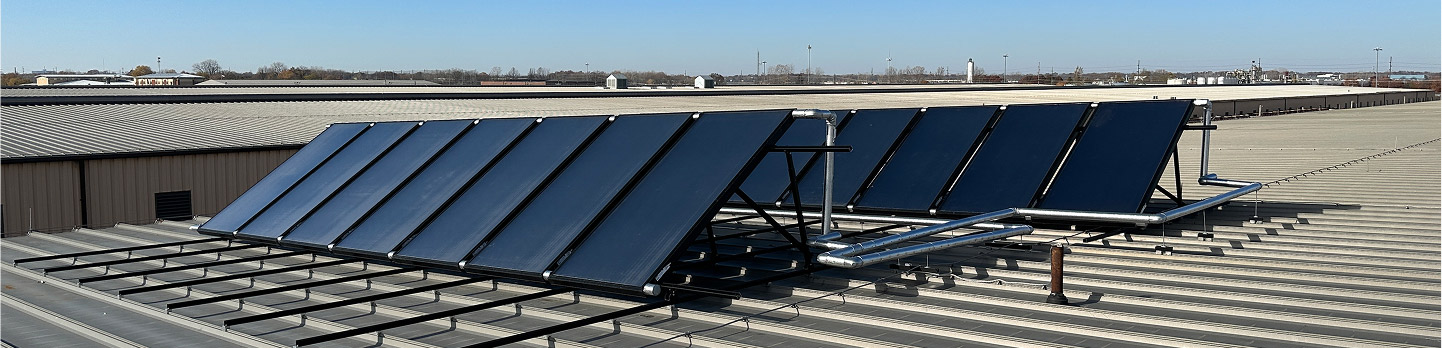
Why Solar Thermal Is Back in Focus
Across the built environment, decarbonization efforts have accelerated. Policies, incentives, and technology development have largely focused on electrification as the primary path forward.
But beneath that momentum, a critical reality remains:
A significant portion of building emissions comes from heat.
Domestic hot water, space heating, and process loads represent a major share of Scope 1 emissions, the direct emissions generated on-site through fuel consumption. Addressing these loads is essential to achieving meaningful reductions.
Understanding Scope 1 Emissions in Buildings
Scope 1 emissions are produced directly from sources owned or controlled by a building or facility.
In most commercial and residential applications, this includes:
- Gas-fired water heating systems
- Boilers used for space heating
- Process heating equipment in industrial settings
These systems are reliable and widely deployed—but they are also a primary source of on-site carbon emissions.
The Electrification Conversation - and Its Limits
Electrification has become a central strategy in reducing emissions, particularly through technologies like heat pumps.
While effective in many applications, electrification introduces new considerations:
- Increased electrical demand on the grid
- Performance variability based on climate and load conditions
- Infrastructure requirements to support higher peak loads
Heat pumps improve efficiency, but they do not eliminate the underlying demand—they shift it.
As more systems transition to electric, grid capacity and peak demand management become increasingly important factors.
A Shift Toward Load ReductionDecarbonization is not only about changing the energy source. It is about reducing the load itself.
This is where solar thermal re-enters the conversation.
Rather than converting electricity into heat, solar thermal systems generate usable heat directly from sunlight. This distinction matters.
It allows buildings to:
- Reduce reliance on fuel-based systems
- Offset electric demand before it reaches the grid
- Deliver measurable reductions in on-site emissions
Solar thermal systems address the core challenge of Scope 1 emissions by targeting the source of the load.
Key advantages include:
Direct Thermal Energy
Solar thermal produces heat without intermediate conversion, improving efficiency and reducing system complexity.
Immediate Load Offset
Hot water and heating loads can be partially or fully offset, depending on system design and application.
Reduced Grid Dependency
By generating heat on-site, solar thermal systems reduce the need for additional electrical infrastructure and peak demand.
Proven Performance
With decades of field performance, solar thermal systems offer a reliable and scalable solution for a wide range of building types.
Applications Across the Built Environment
Solar thermal is particularly effective in applications with consistent thermal demand:
- Multifamily housing and centralized hot water systems
- Hotels and hospitality facilities
- Healthcare and institutional buildings
- Industrial and process heating environments
These applications benefit from:
- Predictable load profiles
- Opportunities for storage and load management
- Long-term operational savings
Solar thermal is not positioned as a replacement for all technologies; it is a complementary solution.
In many cases, it is integrated into hybrid systems that include:
- Heat pumps
- Boilers for backup or peak demand
- Thermal storage systems
This approach allows designers and engineers to:
- Reduce system sizing requirements for electric equipment
- Improve overall system efficiency
- Create more resilient and adaptable energy systems
The Broader Opportunity
As decarbonization strategies evolve, the focus is expanding beyond electrification alone.
The conversation is shifting toward:
- Total system performance
- Grid impact and peak demand
- Long-term operational stability
Solar thermal plays a critical role in this shift by addressing one of the most energy-intensive and emissions-heavy aspects of building operation; heat.
A Renewed Focus on Thermal EnergyFor decades, solar thermal has delivered reliable performance across residential, commercial, and industrial applications.
Today, it is being reevaluated through a new lens:
- As a tool for reducing Scope 1 emissions
- As a way to balance electrification strategies
- As a scalable solution for high-demand thermal loads
Decarbonization is not defined by a single technology choice. It is defined by outcomes.
Reducing emissions requires solutions that:
- Address real-world energy use
- Deliver measurable results
- Integrate into modern building systems
Solar thermal meets these criteria by focusing on the load itself.
It reduces the energy required before it needs to be generated, converted, or distribute
Looking AheadAs building codes, policies, and market expectations continue to evolve, the role of solar thermal is becoming increasingly clear.
It is not a legacy technology.
It is a practical, proven solution for one of the most important challenges in the energy transition.
It’s not just sustainability. It’s sovereignty.