
Reducing Building Energy Costs Without Increasing Electrical Load
Electricity demand is growing across the United States.
Data centers, manufacturing, transportation, cooling, building electrification, and other expanding loads are changing how utilities, engineers, facility managers, and building owners think about energy planning.
According to the U.S. Energy Information Administration’s July 2026 Short-Term Energy Outlook, U.S. electricity generation is projected to increase from 4,430 billion kilowatthours in 2025 to 4,502 billion kilowatthours in 2026 and 4,636 billion kilowatthours in 2027. U.S. solar generating capacity is also projected to continue expanding during that period.
More renewable electricity will be an important part of meeting future demand.
But increasing generation is only one side of the energy equation.
Commercial buildings must also consider a second question:
Should every building energy load be converted to electricity?
Electrification will remain an important component of building decarbonization. Heat pumps, electric vehicles, advanced building controls, renewable electricity, and energy storage are helping reshape the built environment.
However, effective energy planning is not necessarily about electrifying every system in every building.
It is about selecting the most appropriate energy solution for each load.
For facilities with significant domestic or process hot water demand, renewable thermal technologies can reduce conventional energy consumption without creating another major electrical load.
That distinction may become increasingly valuable as electrical capacity is needed for a growing number of building systems.
What is solar thermal?
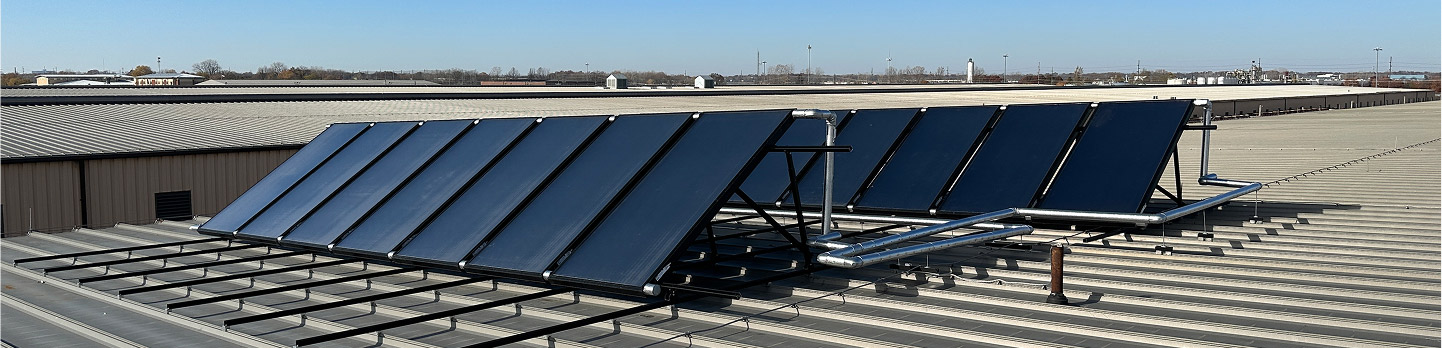
Solar thermal systems capture energy from sunlight and use it to produce usable heat.
In a commercial solar water heating system, solar collectors absorb thermal energy and transfer that heat into a building’s water-heating system. The collected energy can reduce the amount of electricity, natural gas, propane, or other conventional energy required to meet the building’s hot water demand.
Unlike photovoltaic solar panels, which generate electricity, solar thermal collectors produce heat directly.
That makes solar thermal particularly relevant when the required end use is already thermal.
In simple terms:
Photovoltaic systems turn sunlight into electricity.
Solar thermal systems turn sunlight into heat.
Both technologies can contribute to a more efficient energy future, but they solve different building needs.
How can solar thermal reduce electrical load?
A conventional electric water-heating system uses electricity to generate heat.
A solar thermal system captures heat directly from the sun and transfers it into the water-heating process. Depending on system design, climate, hot water demand, and other project conditions, solar energy can offset a portion of the building’s conventional water-heating requirements.
This can reduce the amount of electricity that would otherwise be required to produce the same thermal energy.
For buildings considering new electric water-heating equipment, or evaluating broader electrification strategies, solar thermal may provide another pathway:
Reduce the energy required for hot water before adding more electrical demand.
Solar thermal does not eliminate the need for backup or supplemental energy. Commercial systems are typically designed to work alongside conventional water-heating equipment to provide reliable hot water under changing weather and operating conditions.
The objective is not necessarily to replace every energy source.
The objective is to reduce how much conventional energy the building must purchase and consume.
Why does electrical capacity matter for commercial buildings?
Electrical capacity affects far more than a building’s utility bill.
As buildings add electric equipment, owners and project teams may need to evaluate:
-
Available electrical service capacity
-
Peak electrical demand
-
Utility infrastructure
-
Electrical distribution equipment
-
Future expansion plans
-
Capital costs associated with service upgrades
-
Competing electrical loads within the facility
Not every project will experience an electrical capacity constraint. However, as more systems rely on electricity, understanding where electrical energy provides the greatest value becomes increasingly important.
A building may need electrical capacity for cooling, ventilation, lighting, vehicle charging, industrial equipment, computing infrastructure, and other critical operations.
Reducing the electrical energy required for water heating may help preserve capacity for systems that have fewer practical alternatives.
Which commercial buildings may benefit from solar water heating?
Solar thermal is generally most relevant in facilities with substantial and consistent hot water demand.
Potential applications include:
Hotels and resorts
Guest rooms, kitchens, laundries, pools, spas, and other amenities can create significant hot water requirements throughout the year.
Multifamily housing
Apartment communities, condominiums, affordable housing developments, dormitories, and other residential facilities may benefit from centralized renewable water heating.
Hospitals and healthcare facilities
Healthcare environments often require dependable hot water for sanitation, cleaning, food service, laundry, and patient needs.
Commercial laundries
Facilities with frequent washing cycles may have large, predictable thermal loads that can support effective solar thermal system design.
Food processing and manufacturing
Certain industrial and commercial processes require heated water or low-temperature process heat.
Car washes
Vehicle washing operations may use significant quantities of heated water throughout the operating day.
Restaurants and institutional kitchens
Food preparation, cleaning, and sanitation can contribute to recurring hot water demand.
Schools, universities, and athletic facilities
Dormitories, cafeterias, locker rooms, pools, and other campus facilities can create multiple opportunities for renewable water heating.
The presence of a large hot water load does not automatically determine whether solar thermal is appropriate. System feasibility also depends on available installation area, climate, water-heating profile, system configuration, energy costs, and project objectives.
Is solar thermal an alternative to electrification?
Solar thermal should not be viewed as a rejection of electrification.
In many projects, the technologies can work together.
For example, a commercial building may use solar thermal to reduce the energy required for domestic hot water while using electric heat pumps, renewable electricity, storage, or other technologies elsewhere in the facility.
The result can be a more diversified energy strategy.
Rather than asking:
“Should this building electrify?”
Project teams may benefit from asking:
“Which loads should be electrified, which loads can be reduced, and which energy technologies are best suited to each application?”
That broader approach gives building owners, engineers, and facility managers more flexibility when evaluating decarbonization, operating costs, infrastructure, and long-term energy performance.
Can solar thermal reduce building operating costs?
Solar thermal can reduce the amount of purchased energy required for water heating.
The financial value of those energy savings depends on several project-specific factors, including:
-
Existing water-heating fuel
-
Local utility rates
-
Daily and seasonal hot water demand
-
Solar resource
-
System size
-
Equipment selection
-
Installation cost
-
Available incentives
-
System operation and maintenance
-
Expected service life
For this reason, commercial solar thermal systems should be evaluated based on site-specific energy use and lifecycle economics rather than a single universal payback estimate.
The strongest applications typically combine substantial hot water demand with favorable installation conditions and a long-term commitment to energy-cost reduction.
What role can solar thermal play in building decarbonization?
Building decarbonization is often discussed primarily in terms of renewable electricity and electrification.
Those strategies are important, but buildings consume energy for different purposes.
Some energy is used to power motors, lighting, electronics, cooling systems, and equipment.
Some energy is used simply to create heat.
When the required end product is hot water, generating renewable heat directly may provide an efficient complement to renewable electricity.
Solar thermal can support building decarbonization by:
-
Reducing conventional water-heating energy use
-
Lowering dependence on fossil-fuel heating
-
Reducing the amount of electricity required for water heating
-
Supporting diversified renewable-energy strategies
-
Integrating with existing or supplemental water-heating equipment
The appropriate solution will vary by building.
The larger point is that renewable heat should be included in the energy-planning conversation.
A more flexible approach to the energy transition
The future of energy will require more electricity.
It will also require more thoughtful use of electricity.
As renewable generation expands and buildings adopt new electric technologies, project teams have an opportunity to evaluate each energy load individually.
Where is electricity essential?
Where can energy use be reduced?
Where can renewable heat serve a thermal load directly?
For commercial buildings with substantial hot water requirements, solar thermal provides an established option for reducing conventional energy use without placing the full water-heating load on the electrical system.
The energy transition is not only about producing more electricity.
It is also about using electricity where it provides the greatest value—and using renewable heat where heat is what the building actually needs.
Frequently Asked Questions
Does solar thermal generate electricity?
No. Solar thermal systems capture energy from sunlight and use it to produce heat. Solar photovoltaic systems generate electricity.
Can solar thermal be used with an existing water heater?
In many applications, yes. Solar thermal systems are commonly designed to operate alongside conventional water-heating equipment, which provides supplemental or backup energy when required.
Does solar water heating work in commercial buildings?
Yes. Commercial solar water heating can be used in facilities with significant domestic or process hot water demand, including hotels, multifamily properties, healthcare facilities, laundries, schools, car washes, and certain industrial applications.
Can solar thermal eliminate a building’s electrical water-heating load?
The amount of conventional energy offset depends on the project. Solar thermal systems are generally designed to supply a portion of annual water-heating demand, while supplemental equipment maintains reliable hot water delivery.
Is solar thermal the same as solar PV?
No. Solar photovoltaic panels convert sunlight into electricity. Solar thermal collectors capture sunlight as usable heat.
Can solar thermal work with heat pumps?
Yes. Solar thermal and heat-pump water heating may be used as complementary technologies, depending on system design and project objectives.
How do I know whether solar thermal is appropriate for a project?
A feasibility assessment should consider hot water demand, available installation area, climate, current energy source, utility costs, system design, project budget, and long-term energy goals.
Explore Commercial Solar Water Heating
Every commercial hot water application is different.
SunEarth works with engineers, contractors, distributors, building owners, and project teams to develop solar thermal solutions for a wide range of commercial and industrial applications.
Explore SunEarth commercial solar water heating solutions or contact our team to discuss the energy requirements of your next project.