
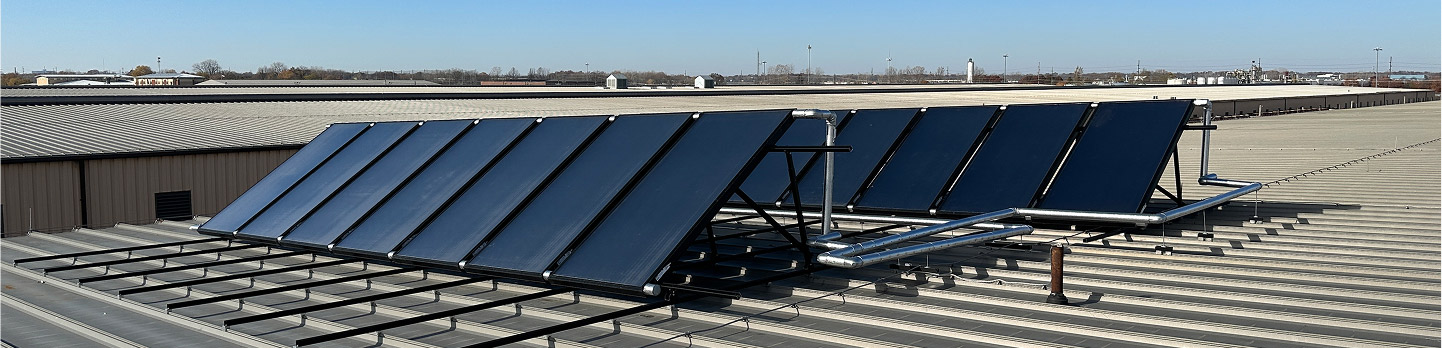
New System, Retrofit, or Recommissioning: Three Paths for Commercial Renewable Heat
Commercial renewable heat does not always start with a blank roof.
Sometimes it begins during new construction, when engineers and project teams are still shaping the building’s domestic hot water strategy.
Sometimes it begins with an existing building that has a significant hot water load and rising operating costs.
Sometimes it begins with a solar thermal system that is already on-site, but no longer performing, no longer understood, or no longer part of the building’s active energy strategy.
Each situation is different.
But all three can lead to the same opportunity:
using renewable heat to support commercial hot water demand.
For building owners, engineers, contractors, facility teams, and distributors, the first step is not always deciding which product to install.
The first step is understanding where the building is today, and which path makes the most sense.
Path 1: New system
A new commercial solar thermal system is often strongest when it is considered early in the design process.
That is when project teams can coordinate the building’s hot water load, roof or ground space, mechanical room layout, storage requirements, backup equipment, controls, and long-term maintenance strategy.
In new construction, solar thermal can be designed as part of the building’s domestic hot water infrastructure from the beginning.
That matters because commercial hot water is not a small side load in many buildings. Hotels, multifamily properties, healthcare facilities, commercial laundries, restaurants, car washes, schools, universities, and some process-water applications may all have meaningful thermal demand.
When that demand is identified early, the system can be designed around the load.
A new system evaluation may consider:
- daily hot water demand,
- peak demand periods,
- temperature requirements,
- collector location,
- storage capacity,
- pump station design,
- controls,
- backup water heating,
- mechanical room coordination,
- maintenance access,
- commissioning requirements.
The advantage of the new system path is coordination.
When solar thermal is evaluated before the mechanical strategy is locked in, it can be integrated more intentionally into the full hot water system.
Path 2: Retrofit
Not every commercial building has the opportunity to start from scratch.
Many properties already have operating water-heating systems, established mechanical rooms, existing roof conditions, and known hot water usage patterns.
That does not mean renewable heat is off the table.
A retrofit project evaluates whether solar thermal can be integrated into an existing building to reduce conventional water-heating energy use and support long-term operating goals.
This path often begins with practical questions:
How much hot water does the building use?
How is that hot water currently produced?
Is the current system meeting demand efficiently?
Is there space for collectors?
Is there room for storage?
Can the solar thermal system work with the existing backup equipment?
What controls or monitoring are needed?
What operational constraints need to be considered?
Retrofits require careful evaluation because the building already has systems in place. That can make the project more complex, but it can also make the opportunity more measurable.
In an existing building, utility history, operating patterns, equipment performance, and maintenance experience can all help shape the conversation.
The goal is not to force solar thermal into every retrofit.
The goal is to identify whether the building has the right thermal demand, physical conditions, and operating priorities to make renewable heat worth evaluating.
Path 3: Recommissioning
The third path is often the most overlooked.
Some commercial buildings already have solar thermal infrastructure on-site.
The collectors may still be on the roof. Storage may still be in the mechanical room. Pumps, controls, valves, piping, and heat exchangers may still exist. But the system may be offline, underperforming, disconnected, poorly documented, or no longer understood by the current facility team.
In those cases, the best question may not be:
Should we replace everything?
The better question may be:
Can this renewable heat asset be evaluated, modernized, and returned to service?
Recommissioning starts with the recognition that existing solar thermal infrastructure can represent real value.
A recommissioning evaluation may include:
- system inspection,
- collector assessment,
- piping and insulation review,
- pump station evaluation,
- storage review,
- controls assessment,
- sensor verification,
- valve and flow review,
- backup integration review,
- operating logic,
- documentation,
- startup and commissioning support.
This path is especially important because solar thermal systems are not disposable infrastructure.
When properly evaluated and supported, existing systems may be able to continue contributing renewable heat to the building’s hot water strategy.
Why recommissioning matters
Recommissioning is not just a maintenance activity.
It is an asset recovery strategy.
A commercial solar thermal system may have been installed years ago to reduce operating costs, support sustainability goals, or provide renewable heat for domestic hot water. If that system is no longer operating, the building may be leaving value on the roof, in the mechanical room, or in the system piping.
SunEarth’s recommissioning work at Hyatt Regency Scottsdale Resort & Spa at Gainey Ranch is a strong example of this opportunity.
The project showed that an existing commercial solar thermal system does not automatically become a sunk cost when it is offline or underperforming. With the right evaluation, modernization, technical coordination, and recommissioning support, renewable heat infrastructure can sometimes be brought back into productive operation.
That distinction matters for facility teams and building owners.
Before abandoning an existing system, it may be worth asking whether the asset can be restored.
The right path depends on the building
New system, retrofit, and recommissioning projects all require different starting points.
But they share the same core question:
What does the building need?
For a new building, the opportunity may be early coordination.
For an existing building, the opportunity may be reducing conventional hot water energy use through retrofit integration.
For a building with an inactive or underperforming solar thermal system, the opportunity may be restoring value from infrastructure that is already in place.
The strongest path is not always the newest path.
It is the path that fits the building’s load, system conditions, project timing, budget, operational needs, and long-term goals.
Where controls and system visibility fit
Modern controls can play an important role across all three paths.
In a new system, controls help support the intended system strategy from the beginning.
In a retrofit, controls can help project teams understand how renewable heat is being integrated into the existing water-heating system.
In a recommissioning project, controls may help restore visibility to a system that has become difficult to understand or support.
That is why controls should not be treated as an accessory.
They are part of the system’s ability to operate, communicate, and be maintained over time.
With SunEarth’s SolFlux intelligent controller, commercial solar thermal systems can be supported with better visibility into system operation, helping engineers, contractors, and facility teams better understand the renewable heat asset they are managing.
Commercial renewable heat starts where the building is
One of the most important ideas in commercial solar thermal is that every project has a starting point.
Some projects are still on paper.
Some are already built.
Some have aging equipment.
Some have existing renewable heat infrastructure that has been forgotten or neglected.
Some have strong hot water demand, but no renewable heat system yet.
A strong evaluation starts by identifying which situation applies.
That is what turns solar thermal from a general product conversation into a project-specific energy strategy.
The takeaway
Commercial renewable heat does not have only one starting point.
It can begin with a new system.
It can begin with a retrofit.
It can begin with an existing solar thermal asset that deserves a second look.
What matters is matching the path to the building.
For commercial properties with significant hot water demand, solar thermal can support long-term energy performance when it is evaluated as part of the complete hot water strategy.
The strongest projects start where the building is, and design for what it needs.
Start Where the Building Is
Commercial solar thermal projects do not all begin the same way.
SunEarth works with engineers, contractors, facility teams, distributors, and building owners to evaluate new systems, retrofit opportunities, existing solar thermal infrastructure, controls, storage, pump stations, and recommissioning needs.
Whether your project is new construction, an existing building, or a system that deserves a second look, the first step is understanding the load, the infrastructure, and the opportunity.
Connect with SunEarth to discuss which path makes sense for your commercial renewable heat project.