
Industrial Process Hot Water: Where Solar Thermal Makes Sense
Following the 2026 Renewable Thermal Collaborative Summit, SunEarth examines how industrial facilities can use solar thermal technology to reduce conventional energy demand, support process hot water, and build more practical renewable heat strategies.
Industrial Decarbonization Starts With Understanding the Heat Load
Industrial decarbonization is often discussed in terms of electricity, fuel switching, and emerging technologies. Yet many industrial operations depend on something more fundamental: reliable heat.
From food processing and agricultural production to industrial cleaning and equipment sanitation, hot water is essential to daily operations. Producing that hot water requires energy, and the cost of supplying it can be a significant consideration for facilities operating throughout the year.
At the October 21–23, 2026 Renewable Thermal Collaborative (RTC) Summit in Arlington, Virginia, industry leaders gathered to examine practical approaches to reducing fossil fuel dependence in industrial heating.
SunEarth participated in the Summit, joining the broader conversation about renewable thermal technologies, industrial energy efficiency, and the challenges of bringing clean heat solutions into commercial operation.
One important consideration for facility owners and engineers is that not every industrial heating application requires the same technology.
For operations that depend on consistent hot-water demand, solar thermal can provide a direct source of renewable heat that works alongside existing heating infrastructure.
Not All Industrial Heat Is High-Temperature Heat
Industrial processes operate across a wide range of temperatures.
Some applications require high-temperature steam or specialized thermal systems. Others depend primarily on heated water for washing, cleaning, sanitation, preheating, and production support.
That distinction matters when evaluating renewable energy technologies.
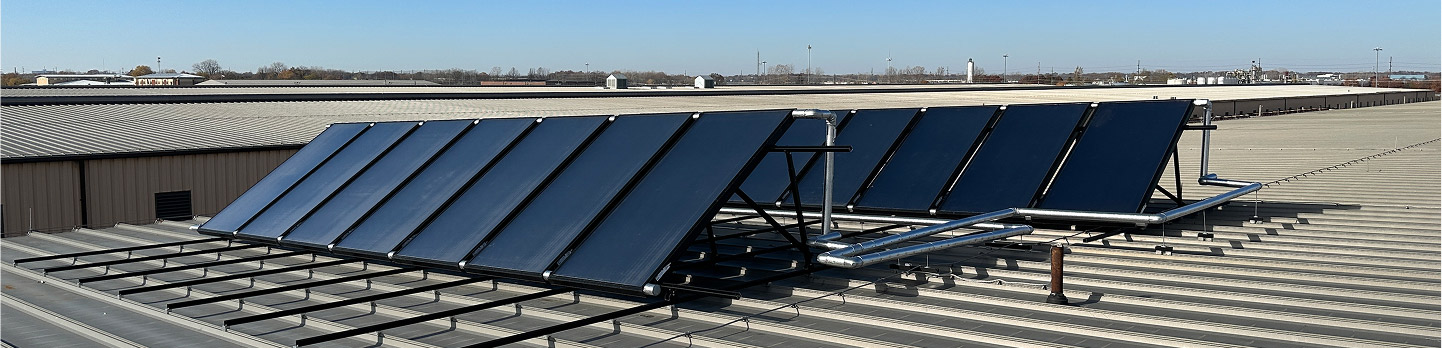
Conventional flat-plate solar thermal collectors are particularly relevant to appropriately designed low- and moderate-temperature water-heating applications. They capture solar radiation and transfer the resulting heat to a circulating fluid, which can then be used to heat water through a properly engineered system.
Rather than replacing an entire industrial heating plant, solar thermal can be incorporated as a preheating resource.
The existing boiler, heat pump, or conventional water heater continues to provide the temperatures and reliability required by the operation.
The result is an opportunity to reduce the amount of purchased energy needed to bring water to its final operating temperature.
Where Industrial Solar Water Heating Can Make Sense
Several industrial and commercial applications offer opportunities to evaluate solar thermal integration.
Food and Beverage Processing
Food and beverage facilities frequently require hot water for equipment cleaning, sanitation, washdown, and process-water preparation.
Where these activities create a substantial, recurring hot-water load, solar thermal may provide useful preheating before water reaches the facility's conventional heating equipment.
The appropriate system configuration depends on daily consumption, incoming water temperature, sanitation requirements, operating schedules, and available installation space.
Agricultural Operations and Dairy Facilities
Agricultural facilities use heated water for equipment washing, sanitation, and processing activities.
Dairy operations, in particular, may have recurring cleaning and sanitation requirements that make hot-water energy consumption an important operating consideration.
Solar thermal systems can be evaluated as part of a broader water-heating strategy, provided the design accounts for required temperatures, operating schedules, and applicable sanitation standards.
Commercial Laundries and Industrial Cleaning
Laundry operations and industrial cleaning facilities can require substantial quantities of heated water.
For operations with consistent daily demand, solar preheating may reduce the energy required from conventional heating equipment.
The opportunity is especially worth investigating when the facility has a predictable load profile and adequate space for solar collectors and thermal storage.
Other Process-Water Applications
Additional opportunities may exist wherever an industrial facility regularly heats incoming water.
The critical question is not simply whether the facility uses heat. It is whether the required temperature, demand pattern, and operating conditions are compatible with a solar thermal system.
The strongest solar thermal opportunities begin with a measurable, recurring thermal load.
Why Thermal Storage Matters
Industrial hot-water demand does not always occur at the same time solar energy is available.
A food processing facility may have cleaning cycles at the end of a production shift. A laundry operation may experience changing demand throughout the day. Agricultural facilities may have predictable morning and evening requirements.
Thermal storage helps address this difference between when heat is generated and when it is needed.
In a properly designed solar thermal system, heated water or another suitable storage medium can retain useful thermal energy for later use.
Storage capacity, operating temperatures, heat losses, and control strategies all influence how effectively that energy can support the facility's load.
For industrial applications, storage should be evaluated as part of the complete system rather than treated as an isolated component.
Solar Thermal and Heat Pumps: Complementary Approaches
Industrial facilities are increasingly evaluating heat pumps, electrification, waste-heat recovery, and other technologies to reduce reliance on conventional fuels.
Solar thermal does not need to compete with every one of these approaches.
Depending on the application, solar thermal may provide renewable preheating while a heat pump or conventional heating system supplies additional temperature lift and backup capacity.
Similarly, facilities considering waste-heat recovery may benefit from evaluating how multiple thermal resources could be integrated.
However, combining technologies does not automatically produce the most economical or efficient system.
Successful integration requires an understanding of temperature requirements, control sequences, storage, equipment compatibility, and the actual operating load.
The objective should be to identify a reliable configuration that reduces conventional energy consumption without compromising the process.
From Renewable Heat Strategy to Practical System Design
For industrial facilities, renewable heat projects begin with engineering questions rather than equipment selection.
Before specifying a solar thermal system, project teams should understand:
-
Daily hot-water demand: How much heated water does the facility use, and when?
-
Required operating temperatures: What temperatures are necessary for each process?
-
Existing heating equipment: Can solar preheating be integrated with the current system?
-
Available installation space: Is there suitable roof or ground area for collectors?
-
Thermal storage requirements: How much useful heat can be stored and delivered?
-
Controls and monitoring: How will solar production, storage, and backup heating operate together?
-
Project economics: How do local energy costs, installation requirements, maintenance, and available incentives affect the investment?
These factors help determine whether solar thermal is appropriate and how it should be incorporated into the facility's overall heating strategy.
SunEarth: Supporting Renewable Heat Beyond Conventional Buildings
For nearly five decades, SunEarth has manufactured solar thermal equipment in the United States, supporting residential, commercial, and industrial water-heating applications.
Its portfolio includes solar thermal collectors, thermal storage solutions, pump stations, and controls that can be incorporated into engineered hot-water systems.
SunEarth works with distributors, contractors, engineers, and project developers to evaluate applications where direct solar heat can reduce dependence on conventional water-heating energy.
For industrial facilities, the opportunity is not to apply solar thermal indiscriminately to every process.
It is to identify the applications where the technology can deliver useful heat reliably and contribute measurable value.
The Next Step for Industrial Renewable Heat
The 2026 RTC Summit reinforced the importance of practical pathways for industrial thermal decarbonization.
For many facilities, the next step does not have to begin with replacing every piece of heating equipment.
It can begin with understanding where energy is being used to produce hot water, whether that demand is suitable for renewable preheating, and how existing infrastructure can be adapted.
Solar thermal offers one established pathway for facilities with the right operating conditions.
Industrial renewable heat starts with the load. The right technology follows.
Explore Solar Thermal for Your Facility
Does your facility use significant quantities of hot water for processing, sanitation, cleaning, or other daily operations?
SunEarth can help your project team explore whether solar thermal belongs in your water-heating strategy.
Explore SunEarth Commercial & Industrial Solutions
Learn About Solar Thermal for Food Processing
SunEarth Inc. | American-Made Solar Thermal Solutions