
If You’re Revisiting the Water Heater, Revisit the Hot-Water System.
Commercial water-heating equipment is changing. The bigger opportunity may be looking beyond the heater itself.
October 6, 2026 marks an important date for commercial water heating in the United States.
The U.S. Department of Energy’s amended energy-conservation standards for commercial water-heating equipment require compliance for equipment manufactured on or after October 6, 2026. The standards cover categories of commercial equipment including storage water heaters, instantaneous water heaters and hot-water supply boilers.
There is an important qualification.
DOE has separately announced an enforcement-discretion policy affecting the thermal-efficiency standards for certain gas-fired commercial water-heating equipment manufactured from October 6, 2026 through October 5, 2027. That policy delays specified enforcement activity; it does not change the October 6, 2026 compliance date itself.
For building owners, engineers and contractors, however, the bigger conversation doesn’t have to be about a regulation.
It can be about the system.
If you’re already revisiting the water heater, it’s worth revisiting how the building produces, stores and manages hot water in the first place.
Don’t Just Replace the Box
When a commercial water heater reaches the end of its useful life, or when equipment specifications change, the natural question is: What should replace it?
That’s an important question.
But it isn’t necessarily the first one.
Before selecting the next piece of equipment, consider asking:
How much hot water does this building actually need, when does it need it, and where should that thermal energy come from?
Commercial hot-water demand is a thermal load.
Hotels need hot water. Apartment buildings need hot water. Healthcare facilities need hot water. Restaurants, universities, recreation facilities and other commercial buildings need hot water.
DOE itself identifies restaurants, hotels, multifamily housing, schools and convention centers among the applications served by commercial water-heating equipment.
The water heater is one way of serving that load.
It doesn’t have to define the entire system.
Start With the Load
A better hot-water conversation begins with demand.
How much hot water does the building use? What does the daily load profile look like? When are the peaks? What temperatures are required? How much storage makes sense? What energy sources are available? What equipment should provide backup? And how should those components work together?
Those questions can lead to a fundamentally different approach than simply replacing one heater with another.
Start with the load. Then design the system around it.
The Primary Heater Doesn’t Have to Produce Every Btu
This is where renewable thermal energy becomes particularly interesting.
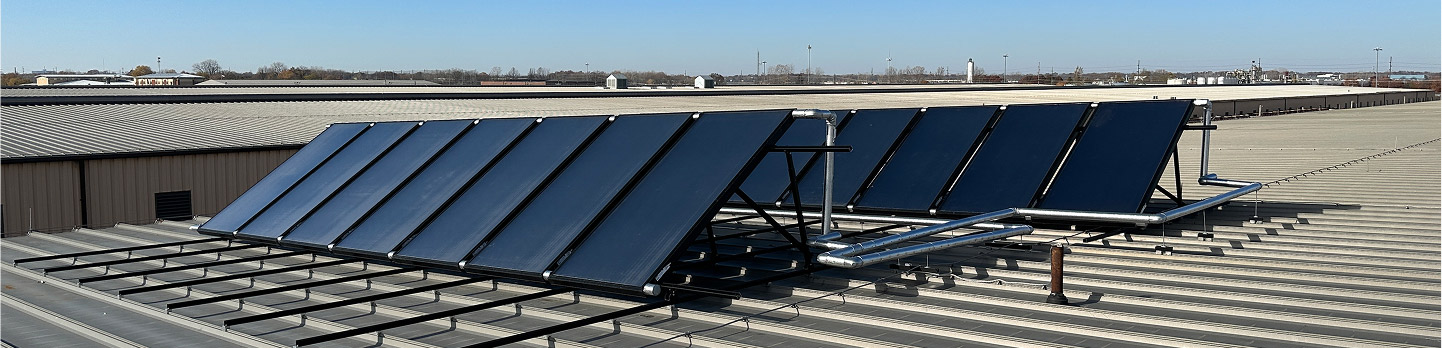
A solar water-heating system can capture solar energy directly as heat and use that energy to preheat water before it reaches the building’s primary or backup water-heating equipment.
That changes the job of the heater.
Instead of asking one piece of equipment to provide the building’s entire thermal load, renewable preheat can serve a portion of that demand first.
The backup heating system then provides the additional energy necessary to reach the required delivery temperature.
That concept doesn’t depend on treating solar thermal and another water-heating technology as competitors.
They can have different jobs within the same system.
Solar thermal provides renewable heat.
Storage helps match energy availability with hot-water demand.
The primary or backup heater supplies what remains.
Controls help manage the system.
The question becomes less about choosing a single technology and more about designing the right combination for the building.
Storage Belongs in the Conversation
Changing water-heating equipment is also an opportunity to reconsider storage.
Hot water itself represents stored thermal energy.
In a solar water-heating system, energy collected when sunlight is available can be transferred into water, retained in insulated storage and used as hot-water demand occurs.
That means renewable-energy production and building demand don’t necessarily have to happen simultaneously.
And storage isn’t simply a question of tank size.
It’s part of how the system matches energy production, recovery capability and the building’s actual load.
DOE’s own definition of commercial water-heating equipment includes unfired hot-water storage tanks, tanks that store water heated externally, underscoring the distinction between producing hot water and storing it.
This Isn’t About Replacing One Technology With Another
The future of commercial hot water doesn’t need to be framed as:
Gas or electric. Heat pump or solar thermal. Renewable or conventional.
For many commercial applications, the better question may be:
What combination of technologies serves this building’s thermal load most effectively?
A building may use solar thermal for renewable preheat. A heat-pump water heater may provide another portion of the load. A conventional system may provide backup or peak capacity. Storage can help manage differences between energy production and demand. Controls can coordinate system operation.
The right answer depends on the building.
That’s why equipment selection should follow load analysis, not replace it.
An Equipment Change Can Be a System-Design Opportunity
The October 2026 changes to commercial water-heating standards create an obvious reason for manufacturers, engineers and building owners to talk about water-heating equipment.
We think there’s an opportunity to make that conversation bigger.
If you’re evaluating new commercial water-heating equipment, don’t look only at the appliance you’re replacing.
Look at the hot-water load. Look at storage. Look at renewable preheat. Look at backup heating. Look at controls. Look at how those pieces work together.
Because the objective isn’t simply to install a water heater.
It’s to design a better hot-water system.
IF YOU’RE REVISITING THE WATER HEATER,
REVISIT THE HOT-WATER SYSTEM.
Start with the load.
SunEarth works with engineers, contractors and building professionals to evaluate commercial hot-water applications and integrate solar thermal into complete water-heating systems.
Bring us the hot-water load. We’ll help you evaluate where renewable heat fits.
Explore SunEarth Commercial Hot-Water Solutions: https://sunearthinc.com/for-business/
Editorial Note
This article is intended to discuss commercial hot-water system design and energy strategy and is not regulatory or compliance guidance. Equipment manufacturers, engineers and other affected parties should consult current U.S. Department of Energy requirements for applicable commercial water-heating equipment.
DOE Commercial Water Heating Equipment Requirements: https://www.energy.gov/cmei/buildings/commercial-water-heating-equipment
DOE Commercial Water Heater Enforcement Policy: https://www.energy.gov/gc/articles/commercial-water-heater-enforcement-policy