
How Solar Thermal Reduces Fossil Fuel Demand in Commercial Buildings
November 9, 2026 | SunEarth Latest News
Every commercial building needs energy.
But not every energy demand needs to be met with electricity or fossil fuels.
In buildings with substantial hot water requirements, a meaningful portion of energy consumption is dedicated to producing heat. That heat supports daily operations in hotels, multifamily properties, hospitals, universities, commercial laundries, and industrial facilities.
For many of these buildings, conventional water heating equipment has long been the default.
But there is another way to approach the load.
Instead of asking only how efficiently a building can produce hot water, we should also ask how much conventional energy it needs to consume to produce it.
That distinction opens the door to renewable heat.
The Energy Demand Behind Hot Water
Commercial hot water is not a minor consideration in buildings with large, recurring thermal loads.
Every shower, laundry cycle, cleaning operation, and process requiring heated water contributes to energy demand.
When that heat comes from natural gas, propane, or other fossil-fueled equipment, the building consumes fuel to meet the load. When it comes from electric water heating, the building places additional demand on its electrical infrastructure.
Both approaches have a role.
But neither means that every unit of heat must originate from a conventional energy source.
Solar thermal provides an opportunity to generate usable heat directly from sunlight, reducing the amount of energy that other heating equipment must supply.
Renewable Heat Changes the Equation
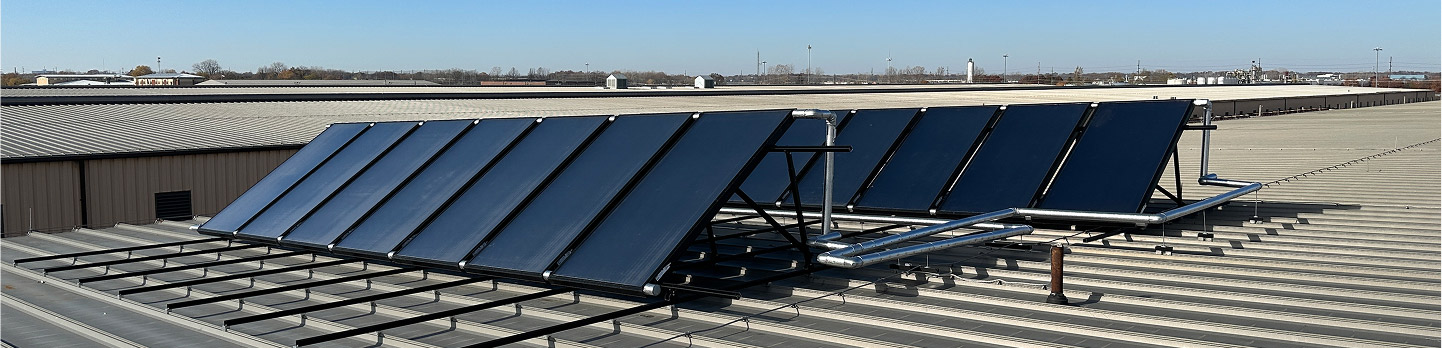
Solar thermal collectors capture solar energy and transfer it into a circulating fluid, creating usable heat for water heating and other compatible thermal applications.
Unlike photovoltaic systems, which convert sunlight into electricity, solar thermal systems are designed to produce heat directly.
That distinction matters when the building's energy requirement is already thermal.
Rather than generating electricity and subsequently converting it into heat, solar thermal supplies renewable energy to the hot water system itself.
In a commercial installation, flat plate solar thermal collectors can work alongside storage tanks, pumps, heat exchangers, controls, and conventional backup equipment.
The objective is not necessarily to eliminate existing heating infrastructure.
It is to reduce how frequently and how much that infrastructure must operate to meet the building's demand.
Every unit of useful solar heat delivered to the load represents energy that does not need to be supplied by the conventional heating system.
What This Means for Building Decarbonization
For buildings that use natural gas or other fossil fuels to produce hot water, reducing fuel consumption can also reduce direct greenhouse gas emissions.
These emissions are commonly categorized as Scope 1 emissions when they originate from fuel-burning equipment owned or controlled by the reporting organization.
Solar thermal can help address this source of emissions by displacing a portion of the heat that would otherwise come from fuel-fired water heating equipment.
The actual reduction depends on the building's existing heating system, solar contribution, load profile, operating conditions, and the amount of conventional fuel displaced.
This is an important distinction.
Decarbonization is not simply about installing renewable energy equipment.
It is about reducing the energy consumption and emissions associated with operating a building.
For facilities with consistent hot water demand, renewable heat offers a practical opportunity to address that objective directly.
Flat Plate Collectors Are Part of a Larger Strategy
The performance of a commercial solar thermal system cannot be evaluated by collector efficiency alone.
Flat plate collectors are responsible for capturing renewable heat, but the value of that heat depends on how the complete system is designed.
Collector area must reflect the building's thermal load.
Storage capacity must support the relationship between solar production and hot water demand.
Controls must manage heat collection and system operation.
Pumps, heat exchangers, and piping must transfer that energy where it is needed.
And conventional heating equipment must remain appropriately integrated to support reliable service.
When these elements work together, solar thermal becomes more than a renewable energy addition.
It becomes part of the building's mechanical infrastructure.
Reducing Fuel Demand Without Sacrificing Reliability
Commercial facilities cannot simply stop producing hot water when solar conditions change.
A hospital still needs hot water during periods of limited sunlight. A hotel still experiences morning and evening demand. A commercial laundry still operates according to production requirements.
That is why solar thermal is frequently integrated with existing or planned heating equipment rather than treated as a standalone replacement.
Solar collectors contribute renewable heat when conditions allow.
Thermal storage helps make that energy available beyond the hours of collection.
Backup equipment provides additional heating when the stored solar contribution is insufficient.
The result is a system designed around the building's actual operating requirements.
This approach can also complement heat pump water heating, electric heating, and hybrid thermal systems.
The broader opportunity is to determine the most effective combination of heat sources, storage, and controls for the application.
A Different Way to Evaluate Building Energy
Commercial energy planning often begins with electricity, equipment efficiency, or fuel costs.
Those conversations are important, but they can overlook a fundamental question:
How much of the building's energy demand is actually a demand for heat?
Understanding that distinction creates opportunities to evaluate solutions based on the energy service the building needs rather than relying exclusively on the equipment traditionally used to provide it.
For projects with meaningful hot water demand, that evaluation should include:
-
The building's daily and seasonal hot water load.
-
The type and amount of conventional energy currently consumed.
-
Opportunities to integrate solar thermal with existing mechanical equipment.
-
Available space for collectors and thermal storage.
-
Long-term operating costs, service requirements, and system performance.
-
The potential to reduce purchased energy and direct emissions.
The answers will vary from one project to another.
But the starting point remains the same: understand the heat demand before determining how best to meet it.
Renewable Heat Belongs in the Energy Conversation
Commercial hot water is an energy strategy.
Hot water storage provides flexibility in when thermal energy is produced and used.
And solar thermal provides a way to generate a portion of that energy without relying on conventional fuel consumption.
Together, these capabilities create opportunities to rethink how commercial buildings produce, store, and deliver heat.
At SunEarth, we believe renewable heat deserves consideration alongside the technologies shaping the future of building energy systems.
Since 1978, SunEarth has manufactured solar thermal technologies designed to support reliable hot water production across residential, commercial, and industrial applications.
Our approach connects solar collection, thermal storage, controls, and system integration around the needs of the building.
Because reducing energy consumption begins with understanding what the building needs energy to do.
Explore SunEarth's commercial renewable heat solutions.
Learn how solar thermal collectors, storage, and system controls can support your next commercial hot water project.