
Hot Water Is Stored Energy
When people talk about energy storage, the conversation usually turns to batteries.
But electricity isn't the only form of energy that can be stored.
Heat can be stored, too.
And when a building's energy demand includes hot water, one of the most familiar forms of thermal energy storage is something buildings have used for generations:
A tank of hot water.
The U.S. Department of Energy defines thermal energy storage as energy stored as heat or cold for use at a different time. Depending on the application, water, molten salts and other materials can all serve as thermal storage media.
For solar water heating, that concept has a remarkably practical application.
Solar energy can be collected as heat when sunlight is available, transferred into water and stored until the building needs it.
The Energy Doesn't Have to Be Used the Moment It's Collected
One of the questions surrounding any renewable-energy system is timing.
What happens when energy is available at one time but the building needs it at another?
For solar electricity, that conversation often leads to batteries.
For solar thermal, the answer can be different.
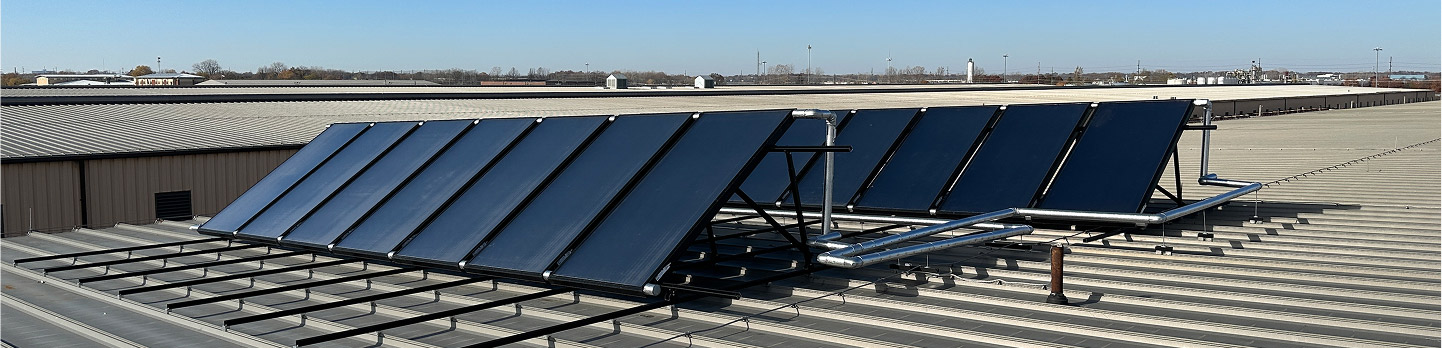
A solar water-heating system captures solar energy as heat. That heat can be transferred into water and held in an insulated storage tank for later use.
In other words:
The sunlight and the hot-water draw don't have to happen at the same moment.
DOE describes this as one of the fundamental purposes of energy storage: capturing energy and making it available at a different time from when it was produced.
Think About What You're Actually Storing
This changes the way we can think about energy storage in buildings.
If the ultimate requirement is electricity, storing electricity may make sense.
But if the ultimate requirement is hot water, converting every conversation about storage into an electrical-storage conversation can overlook the actual load.
The building doesn't necessarily need an electron.
It needs heat.
That leads to a different question:
If the energy we ultimately need is thermal, can we store it thermally?
In a solar water-heating system, the answer is yes.
Sun → Heat → Hot Water → Stored Until Needed
It's an uncomplicated energy pathway.
Solar collectors capture energy from sunlight as heat.
The system transfers that heat into the building's water-heating system.
An insulated storage tank retains the thermal energy.
The building draws on that hot water as demand occurs.
Backup heating can then provide additional energy when necessary based on the system design and application.
Storage Is Part of the System Design
That doesn't mean a larger tank automatically creates a better solar thermal system.
Storage has to be designed around the application.
Hot-water consumption, load profile, collector capacity, available solar resource, operating temperatures, recovery requirements, backup heating and other factors all affect how a system should be configured.
That's why storage isn't simply a tank-selection question.
It's part of how the system matches renewable-energy production to the building's hot-water demand.
For commercial applications with substantial and predictable hot-water loads, understanding that relationship can be especially important.
Hotels.
Multifamily housing.
Healthcare facilities.
Universities and institutional buildings.
Recreation facilities.
Food-service operations.
And other buildings where heating water represents a recurring thermal load.
Thermal Storage Isn't New. The Conversation Around It Is.
DOE continues to research thermal energy storage across a wide range of scales and technologies, from building applications to high-temperature concentrating solar thermal systems. Its building-focused research specifically examines thermal storage as a way to improve flexibility, affordability and energy performance.
The technologies can be dramatically different from a commercial solar water-heating system.
But the underlying energy principle is the same:
Capture heat. Store it. Use it when it's needed.
For solar water heating, we've been applying that principle for decades.
What's changing is the broader conversation around energy storage, and the recognition that storage doesn't have to mean only electricity.
Start With the Energy the Building Needs
That's why conversations about renewable energy should begin with the load.
What does the building actually need?
If it needs electricity, that's an electrical load.
If it needs hot water, that's a thermal load.
And once we understand the load, we can evaluate the technologies that make sense for producing, storing and managing that energy.
Sometimes that includes solar thermal.
Sometimes it includes heat-pump water heating.
Sometimes it includes conventional backup.
And increasingly, the strongest commercial energy strategies may integrate multiple technologies rather than asking one technology to do everything.
Not all energy storage needs a battery.
When the energy you need is heat, hot water can store it.
Start with the hot-water load.
Explore SunEarth commercial solar water-heating systems, storage solutions and engineering resources to learn how renewable thermal energy can become part of your building's energy strategy.