
Five Questions Engineers Should Ask Before Sizing Commercial Hot Water
Better commercial hot water design starts before equipment selection.
Before a project team decides on collectors, tanks, pump stations, controls, backup equipment, or mechanical-room layout, it needs to understand the building’s actual hot water demand.
That is especially important for commercial buildings with meaningful domestic hot water, laundry, kitchen, pool, sanitation, or process-water loads.
In those applications, hot water is not a small detail.
It is part of daily building performance.
For engineers, plumbing designers, contractors, and facility teams, the right questions can help determine whether a project is a strong candidate for conventional water heating, renewable preheat, solar thermal, retrofit integration, or recommissioning.
The strongest systems start with the load.
Then the design follows.
1. How much hot water does the building actually use?
Every commercial hot water strategy should begin with demand.
Not assumptions.
Not generic building type.
Actual use.
A hotel, multifamily property, restaurant, healthcare facility, laundry, car wash, school, or industrial building may all use hot water very differently. Even within the same category, demand can vary based on occupancy, operating hours, fixtures, laundry schedules, kitchen use, pool or spa needs, sanitation requirements, and process loads.
Before sizing equipment, project teams should ask:
- How much hot water is used each day?
- When does demand occur?
- What are the peak usage periods?
- Is the load consistent or seasonal?
- Are there separate loads that should be evaluated independently?
- Is hot water tied to core building operations?
This first question matters because commercial solar thermal is strongest when there is meaningful, recurring thermal demand.
If the building has a strong hot water load, renewable heat may deserve a place in the strategy.
2. When does peak demand happen?
Daily hot water volume is important, but timing matters too.
A building may use a large amount of hot water in short peaks, steady demand throughout the day, or predictable operating windows.
That timing affects storage, backup equipment, pump station design, controls, and how renewable heat is integrated into the system.
Hotels may see morning and evening guest-demand peaks.
Commercial laundries may have demand tied to production schedules.
Restaurants may need hot water around preparation, service, and cleaning periods.
Healthcare facilities may require more continuous hot water availability.
Car washes may have demand linked to business hours and weather patterns.
Multifamily buildings may see repeated daily peaks tied to resident routines.
Solar thermal does not need to meet every peak by itself.
But the system should be designed around how the building actually uses hot water.
Peak demand helps determine how much storage is needed, how backup equipment should support the load, and how the system should respond when renewable heat is available.
3. What temperature does the building need?
Hot water design is not only about volume.
It is also about temperature.
Different commercial applications may require different delivery temperatures, storage temperatures, mixing strategies, sanitation considerations, process requirements, and backup support.
A domestic hot water system for a multifamily building may not have the same requirements as a commercial laundry, healthcare facility, restaurant, or industrial process-water application.
Before sizing a system, engineers should ask:
- What delivery temperature is required?
- What storage temperature is needed?
- Are there sanitation or code considerations?
- Does the application require low-, medium-, or higher-temperature hot water?
- Can renewable heat provide useful preheat even if backup equipment is still required?
- How will temperature be monitored and controlled?
This is where solar thermal often fits well as part of a broader water-heating strategy.
Solar thermal can support renewable preheat, reduce the amount of conventional energy required, and work alongside backup equipment to help the building meet final delivery requirements.
The point is not always to eliminate backup heat.
The point is to reduce how much conventional energy the building needs to produce hot water.
4. How will the system store and move heat?
Commercial hot water is a system, not a single piece of equipment.
Storage, pump stations, piping, insulation, valves, heat exchangers, sensors, and controls all affect how heat is captured, moved, held, and delivered.
This is especially important when renewable heat is part of the strategy.
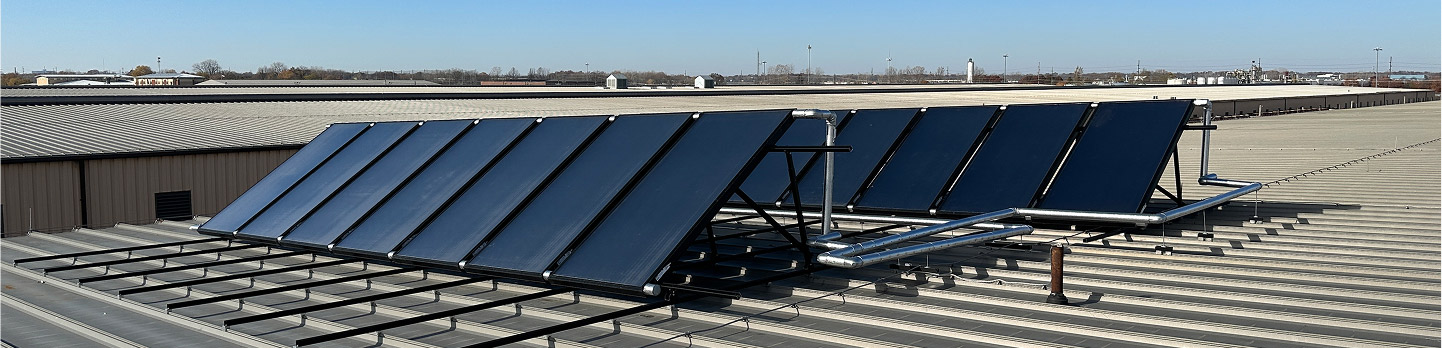
Solar thermal collectors capture heat when solar energy is available. The building may need hot water at different times. Storage helps align renewable heat production with building demand.
Pump stations and piping move heat through the system. Controls help determine when the system should operate. Sensors provide the information needed to understand system conditions.
Before finalizing design, project teams should ask:
- How much storage is needed?
- Is there space for storage in the mechanical room?
- How will heat move from collectors to storage?
- Will the system require a heat exchanger?
- How will piping be insulated and routed?
- How will pump stations, valves, and sensors support operation?
- How will the system be commissioned?
This is why commercial solar thermal should not be treated as collectors on a roof.
The value comes from the full system.
5. Where does renewable heat fit in the overall hot water strategy?
Once the load, timing, temperature, storage, and system layout are understood, project teams can ask the most important strategic question:
Where does renewable heat fit?
For some buildings, the opportunity may be a new solar thermal system designed into the project early.
For others, it may be a retrofit that adds renewable preheat to an existing water-heating system.
For buildings with existing solar thermal infrastructure, it may be recommissioning — evaluating whether an offline or underperforming system can be modernized and returned to service.
Renewable heat may support:
- domestic hot water,
- commercial laundry,
- kitchen operations,
- pools and spas,
- sanitation,
- car wash operations,
- institutional hot water,
- low- to moderate-temperature process loads.
This question helps move the conversation from equipment selection to system strategy.
The goal is not to force solar thermal into every building.
The goal is to identify whether the building has the right thermal demand, physical conditions, and operating priorities for renewable heat to create value.
A practical hot water design checklist
Before sizing a commercial hot water system, project teams should document:
- building type and primary hot water uses,
- daily hot water volume,
- peak demand periods,
- delivery temperature requirements,
- storage needs,
- available roof, ground, or structural space,
- mechanical room constraints,
- existing water-heating equipment,
- backup energy source,
- controls and monitoring needs,
- maintenance access,
- commissioning requirements,
- operating cost goals,
- decarbonization or energy-performance goals,
- existing solar thermal infrastructure, if applicable.
This checklist can help identify whether the project is best approached as a new system, retrofit, recommissioning opportunity, or conventional water-heating upgrade.
Better hot water design starts earlier than equipment selection
Commercial hot water is often treated as an equipment-sizing exercise.
But for buildings with significant thermal demand, the better conversation starts earlier.
Before equipment is selected, project teams should understand the building’s hot water profile, how demand changes throughout the day, what temperatures are required, what storage strategy makes sense, and whether renewable heat can reduce the amount of conventional energy needed to meet the load.
That early evaluation matters because decisions about roof space, mechanical room layout, storage, controls, backup equipment, piping, and commissioning all affect long-term system performance.
When renewable heat is considered too late, the project may lose opportunities for better integration.
When it is considered early, solar thermal can be evaluated as part of the complete domestic hot water strategy, not as an afterthought.
For engineers, contractors, and facility teams, the goal is not simply to size equipment.
The goal is to design a hot water system that fits the building.
What the answers reveal
The five questions in this article are not just a checklist.
They help project teams understand which path makes the most sense.
A building with a consistent daily hot water load may be a strong candidate for solar thermal evaluation.
A building with limited mechanical room space may require a different storage or integration strategy.
A building with existing equipment may be better suited for retrofit integration.
A property with an older or inactive solar thermal system may deserve a recommissioning review before the infrastructure is written off.
And a new construction project may benefit from evaluating renewable heat before the domestic hot water strategy is finalized.
The answers help determine whether the opportunity is:
a new system,
a retrofit,
a recommissioning project,
or a conventional hot water upgrade with future renewable heat planning.
That is why the best commercial hot water conversations start with the building’s actual load, not a product list.
The takeaway
Commercial hot water sizing should start with better questions.
How much hot water does the building use?
When does demand occur?
What temperature is needed?
How will heat be stored and moved?
Where does renewable heat fit?
For buildings with significant hot water demand, those questions can reveal opportunities for solar thermal, renewable preheat, retrofit integration, or recommissioning.
The strongest commercial hot water systems are not built around assumptions.
They are designed around the load.
Before You Size, Understand the Load
SunEarth works with engineers, contractors, distributors, facility teams, and building owners to evaluate commercial hot water demand, solar thermal opportunities, storage, controls, pump stations, retrofit integration, and recommissioning needs.
If your project includes significant domestic hot water, laundry, kitchen, pool, sanitation, or process-water demand, renewable heat may deserve a closer look.
Connect with SunEarth before your next commercial hot water strategy is finalized.