
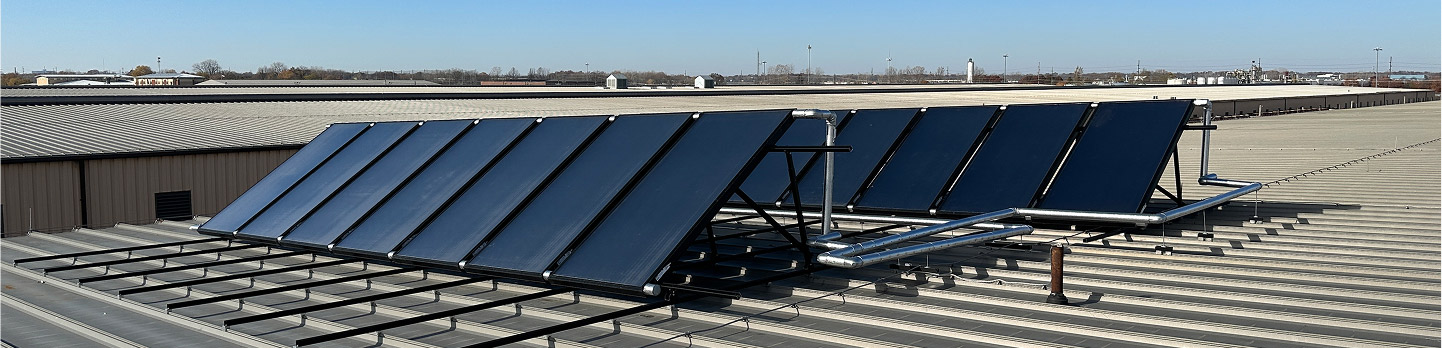
Five Decades of Solar Heat. And We’re Still Building What Comes Next.
This September, the international solar thermal community is marking a significant milestone.
The International Energy Agency’s Solar Heating and Cooling Programme is celebrating 50 years of international research collaboration during EuroSun2026 in Freiburg, Germany. The anniversary event, scheduled for September 15, will recognize five decades of research and innovation in solar heating and cooling while also looking toward the program’s future.
For SunEarth, the milestone hits particularly close to home.
SunEarth was incorporated in California in May 1978, just as the modern solar thermal industry was beginning to take shape. From the beginning, the company’s work centered on engineering and manufacturing equipment that could put solar energy to work as something buildings have always needed:
Heat.
Nearly five decades later, the technology has evolved considerably.
The need for renewable heat hasn’t gone away.
The Beginning of a Solar Thermal Industry
The late 1970s were a formative period for solar heating.
Internationally, researchers, engineers and policymakers were beginning the collaborative work that would eventually span five decades through IEA SHC.
In California, SunEarth was beginning its own chapter.
SunEarth was founded in Santa Rosa in 1978, and that same year the Empire Collector began the SunEarth line of solar hot-water collectors.
Those early systems were built around a straightforward idea: capture solar energy as heat and use it to heat water.
It is an idea that remains remarkably relevant today.

From the SunEarth archives.
Five Decades of Building Better Systems
What has changed over nearly five decades is everything we've learned about how to do it better.
SunEarth's history reflects that evolution.
New collector technologies were developed and acquired. Manufacturing processes advanced. Mounting systems changed. Controls became more sophisticated. Modeling and simulation became increasingly important to system design. And solar water heating expanded into a broader range of residential, commercial and institutional applications.
The company's timeline includes the addition of technologies such as CopperHeart, SunSiphon and SunBurst; the development of mounting solutions; and eventually the introduction of the ThermoRay collector for commercial applications.
The manufacturing itself evolved, too. SunEarth's traditional SunBurst absorber manufacturing process uses roll-formed copper bonded to a copper header and riser assembly, while newer ThermoRay manufacturing incorporated laser welding to produce high-efficiency absorber plates for applications including commercial systems.
But through all that evolution, the underlying objective remained the same:
Turn sunlight into useful heat.

From the SunEarth archives.
From Collectors to Complete Energy Systems
Today, the conversation around solar heating is becoming broader.
EuroSun2026 itself demonstrates just how much the field has expanded. This year's conference covers sustainable heating and cooling for buildings, industrial process heat, thermal energy storage, solar thermal and PVT collectors, energy infrastructure, electrification and the broader sustainable-energy transition.
That's important.
Because the future of renewable heat isn't simply about putting a collector on a roof.
It's about understanding the load.
It's about storage.
It's about controls and monitoring.
It's about system performance.
And increasingly, it's about understanding how solar thermal can work alongside other technologies as part of a better-designed energy system.
That evolution is visible within SunEarth as well. What began with solar collectors now includes engineering and system-design support, simulation and modeling, mounting hardware, controls and integrated solar water-heating solutions. The company's technical capabilities have included plan review, mechanical engineering support, CAD details and system simulation.
The Next Chapter of Renewable Heat
Perhaps the most interesting thing about IEA SHC's 50th anniversary is that the organization isn't treating it simply as an opportunity to look backward.
Current IEA SHC work includes research into the lifecycle and cost of heating and cooling technologies, compact thermal energy storage and other technologies shaping the next generation of heating systems. The organization says its anniversary celebration will also provide a first look at the future direction of the program.
That feels appropriate.
Because after five decades, solar heating isn't a historical technology.
It is an established technology being asked new questions.
How should renewable heat integrate with electrification?
How should thermal energy be stored?
How can better controls improve system performance?
Where does solar thermal make the most sense within commercial and industrial energy systems?
And how do we take decades of installed experience and use it to design the next generation better?
Those are questions worth asking.
Nearly Five Decades at SunEarth
SunEarth's own history has included acquisitions, partnerships, new manufacturing processes, new products and new generations of people building them.
In 2003, the company moved to its five-acre property in Fontana, California, including a newly constructed facility specifically designed for solar-product manufacturing. In 2014, SunEarth's parent company, The Solaray Corporation, became 100% employee-owned.
Today, the people building SunEarth products aren't simply working for a company that has been part of solar thermal's history.
As employee owners, they're helping determine what its next chapter looks like.
And that's why a 50-year milestone for the broader solar heating and cooling community is worth recognizing.
Not because the work is finished.
Because it isn't.
Five decades of solar heat have taught this industry a lot.
Now we get to build what comes next.
Renewable heat. Engineered for what's next.
Explore SunEarth commercial solar water-heating solutions, technical resources and system-design support.