
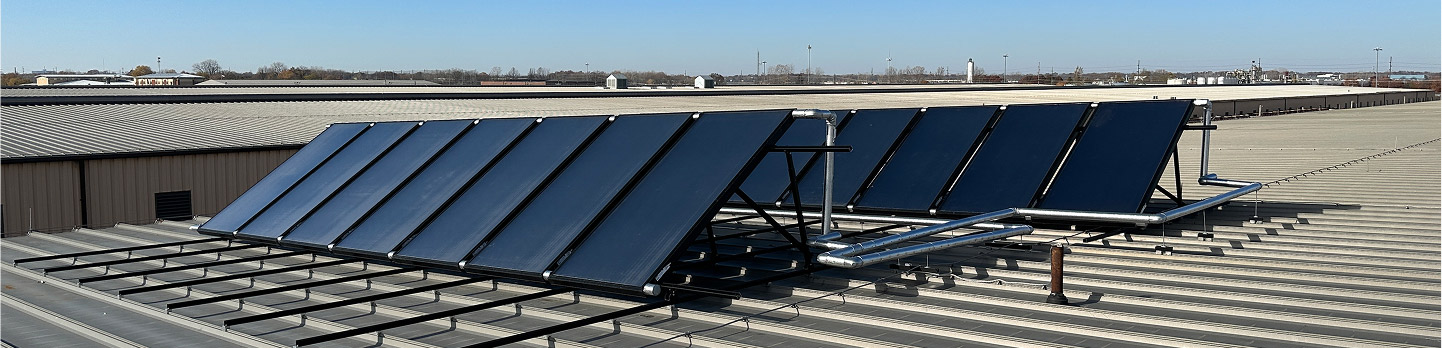
Does Your Building Have the Right Load for Commercial Solar Thermal?
Commercial solar thermal is not a one-size-fits-all solution.
That is exactly why it can be so valuable in the right applications.
The strongest commercial solar water heating projects usually begin with one important question:
Does the building have a meaningful, consistent thermal load?
In other words: does the building use enough hot water, often enough, to justify evaluating renewable heat as part of the energy strategy?
For commercial buildings with significant domestic hot water, laundry, kitchen, pool, spa, sanitation, or process-water demand, solar thermal can help reduce conventional water-heating energy use while supporting long-term operating cost management and decarbonization goals.
The key is matching the technology to the load.
Start with the thermal load
Before a project team evaluates collectors, tanks, pumps, controls, or roof area, it should first understand how the building uses hot water.
A thermal load is the part of a building’s energy demand that requires heat. In commercial buildings, that often includes:
- domestic hot water,
- commercial laundry,
- kitchens and food service,
- pools and spas,
- sanitation,
- low-temperature process hot water,
- car wash operations,
- institutional hot water demand.
Commercial solar thermal is often most effective when that demand is predictable and recurring.
A building that uses small amounts of hot water irregularly may not be a strong candidate. A building that uses significant hot water every day may deserve a closer look.
Five signs a building may be a strong solar thermal candidate
1. The building uses hot water every day
Consistent daily demand is one of the strongest indicators that solar thermal should be evaluated.
Hotels, resorts, multifamily buildings, healthcare facilities, commercial laundries, food service operations, schools, universities, and car washes often have recurring hot water needs. That regular demand gives a solar thermal system more opportunity to contribute useful heat.
The more consistent the load, the easier it is to evaluate how renewable heat may support the building’s water-heating strategy.
2. Hot water is a meaningful operating cost
Solar thermal is most compelling when hot water is not a minor expense.
If a property spends significant energy producing hot water, reducing that conventional energy use can become part of a broader cost-management strategy.
This is especially relevant for buildings where hot water supports core operations:
· guest comfort,
· resident use,
· cleaning and sanitation,
· laundry,
· food preparation,
· production,
· service delivery.
When hot water is tied directly to daily operations, it deserves more than a quick equipment replacement conversation.
It deserves an energy strategy.
3. The building has available space for collectors
Solar thermal systems need suitable space for collectors.
That may include roof area, ground-mount area, parking structures, or other available surfaces depending on the project. The best location depends on solar exposure, structural considerations, system design, maintenance access, and integration with the existing mechanical system.
Not every building has the right available area.
But when a building has both meaningful hot water demand and usable collector space, solar thermal becomes a much more practical conversation.
4. The building has storage or can support storage
Commercial water heating is not just about producing heat.
It is also about storing and delivering hot water when the building needs it.
Storage helps align solar heat production with building demand. In many commercial applications, storage is a major part of the system strategy because hot water use may vary throughout the day.
A good solar thermal evaluation should consider:
· existing storage capacity,
· available mechanical room space,
· backup water-heating equipment,
· peak demand,
· daily usage patterns,
· recirculation,
· controls,
· maintenance access.
Collectors matter, but they are only one part of the system.
5. The project team is thinking beyond first cost
Commercial solar thermal is best evaluated as infrastructure, not as a simple appliance replacement.
The right conversation includes:
· operating costs,
· energy-cost exposure,
· equipment life,
· system controls,
· maintenance,
· incentives,
· emissions goals,
· commissioning,
· long-term performance,
· lifecycle value.
For some buildings, the lowest-cost equipment option may be sufficient.
For others, especially buildings with large recurring hot water demand, it may be worth evaluating how renewable heat can reduce conventional energy use over time.
Building types that often deserve evaluation
Commercial solar thermal may be worth evaluating for many different facility types, including:
· Hotels and resorts
Hotels can have substantial hot water demand from guest rooms, kitchens, laundries, pools, spas, and back-of-house operations. Because hot water is tied directly to guest comfort and daily operations, it should be treated as a strategic load.
· Multifamily housing
Apartments, affordable housing, senior living, student housing, and condominiums may have centralized domestic hot water demand that occurs every day. These projects can be strong candidates when demand is consistent and system design is coordinated early.
· Healthcare facilities
· Hospitals, care facilities, and healthcare campuses often require reliable hot water for sanitation, cleaning, food service, laundry, and patient needs. Reliability and integration with backup systems are especially important.
· Commercial laundries
Laundry operations can create predictable, high-volume thermal demand. These projects should evaluate daily load, operating schedule, temperature requirements, storage, and backup capacity.
· Restaurants and institutional kitchens
Food service operations use hot water for cleaning, sanitation, and daily kitchen operations. Larger facilities, cafeterias, and institutional kitchens may deserve evaluation.
· Car washes
Car washes can require significant heated water during operating hours. Load profile, water volume, and operating schedule are key considerations.
· Schools and universities
Campuses may include dormitories, dining halls, locker rooms, athletic facilities, pools, and other buildings with hot water demand. These loads should be evaluated separately rather than grouped into one general energy strategy.
· Industrial and process-water applications
Some commercial and industrial facilities require low- to moderate-temperature hot water for process needs. These applications should be evaluated carefully based on temperature, volume, timing, and operational requirements.
New system, retrofit, or recommissioning?
A strong solar thermal opportunity does not always mean a new system.
Some buildings may already have solar thermal infrastructure that is underperforming, offline, or no longer well understood by the current facility team.
In those cases, the first step may be an evaluation.
SunEarth’s recent recommissioning work at Hyatt Regency Scottsdale Resort & Spa at Gainey Ranch is a reminder that existing renewable heat assets can sometimes be restored, modernized, and returned to service.
For building owners and facility teams, that creates three possible pathways:
New construction
Evaluate solar thermal early, while domestic hot water demand, storage, mechanical space, controls, and backup equipment are still being designed.
Retrofit
Assess whether solar thermal can be integrated into an existing water-heating system to reduce conventional energy use.
Recommissioning
Evaluate whether an existing solar thermal system can be restored, modernized, or brought back into productive operation.
Each pathway begins with the same question:
What is the building’s actual hot water load?
The questions to ask before specifying equipment
Before deciding whether commercial solar thermal makes sense, project teams should ask:
- How much hot water does the building use each day?
- When does peak demand occur?
- What temperature does the building need?
- How is hot water currently produced?
- What fuel or energy source is currently used?
- How much storage does the building have?
- Is there available roof, ground, or structural space for collectors?
- Is the priority operating cost, emissions reduction, resilience, electrical capacity, or asset recovery?
- Is there an existing solar thermal system on-site?
- Who will operate and maintain the system over time?
These questions help move the conversation from product selection to system strategy.
That is where commercial solar thermal belongs.
Solar thermal works best when it is matched to the right application
Commercial solar thermal remains highly relevant when it is applied where heat is actually needed.
It is not intended for every building.
It is not a replacement for every technology.
It is a renewable heat strategy for buildings with meaningful thermal demand.
When a building has recurring hot water use, suitable installation conditions, appropriate storage, and long-term operating cost goals, solar thermal deserves a place in the conversation.
The strongest projects start with the load.
Then the system is designed around it.
The takeaway
A building does not need to be “solar-ready” in a generic sense.
It needs the right thermal profile.
For commercial buildings with significant hot water demand, solar thermal can help reduce conventional water-heating energy use, support decarbonization goals, and create long-term value as part of a broader energy strategy.
Before deciding whether solar thermal is the right fit, start with the better question:
Does your building have the right load?
Start With the Hot Water Load
Commercial solar thermal is most effective when it is evaluated before the mechanical strategy is locked in.
SunEarth works with engineers, contractors, facility teams, distributors, and building owners to review domestic hot water demand, storage, controls, system integration, retrofit opportunities, and existing solar thermal assets.
If your project includes significant hot water demand - or an existing solar thermal system that deserves a second look — now is the time to evaluate the opportunity.
Connect with SunEarth to discuss whether your building has the right load for commercial solar thermal.