
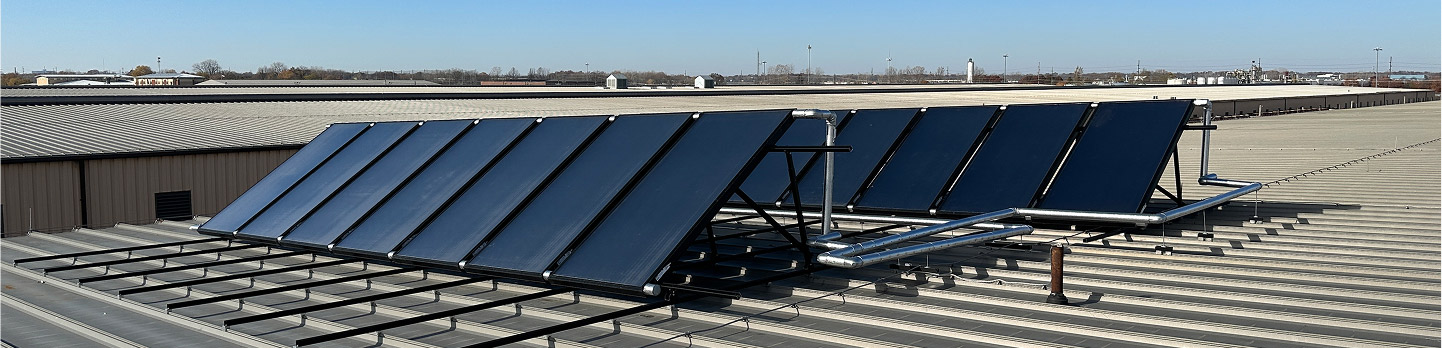
Commercial Solar Thermal Is More Than Collectors
When most people think about solar thermal, they picture collectors on a roof.
That makes sense. Collectors are the most visible part of the system. They are what people see from the ground, in project photos, and on building rooftops.
But in commercial solar water heating, the collectors are only one part of the story.
A strong commercial solar thermal system is not just about capturing heat.
It is about collecting, transferring, storing, controlling, backing up, monitoring, and delivering that heat in a way that supports the building’s actual hot water demand.
That is why commercial solar thermal should be evaluated as a complete system, not as a set of rooftop components.
The collector captures heat. The system delivers value.
Solar thermal collectors do the essential first job: they capture energy from the sun and convert it into usable heat.
But once that heat is captured, it has to move through the system.
It has to be transferred to water or a heat-transfer loop. It may need to be stored until the building needs it. It has to work alongside pumps, sensors, controls, heat exchangers, backup equipment, piping, insulation, valves, and storage tanks.
|
System component |
What it does |
Why it matters |
|
Solar thermal collectors |
Capture solar energy and convert it into heat |
The visible starting point of the system |
|
Storage tanks |
Hold heated water or thermal energy until needed |
Helps align solar production with building demand |
|
Pumps |
Move fluid through the solar loop |
Keeps heat moving through the system |
|
Heat exchanger |
Transfers heat into the building’s water-heating system |
Connects renewable heat to usable hot water |
|
Controls and sensors |
Monitor temperature, flow, and system operation |
Helps the system respond to changing conditions |
|
Piping, valves, and insulation |
Move and protect heat throughout the system |
Reduces losses and supports serviceability |
|
Backup water heating |
Provides hot water when solar contribution is not enough |
Maintains reliability for the building |
|
Commissioning |
Confirms the system is operating as intended |
Turns installed equipment into working infrastructure |
In commercial applications, that matters because hot water demand is rarely random.
Hotels, multifamily buildings, healthcare facilities, restaurants, laundries, car washes, schools, and industrial facilities all use hot water differently. The system has to be designed around that actual load.
Collectors are important.
But they are not the whole strategy.
Storage is where solar thermal becomes useful on the building’s schedule
The sun produces heat when solar conditions are available.
The building uses hot water when operations require it.
Those two things are not always happening at the same time.
That is why storage is such an important part of many commercial solar thermal systems. Storage helps align solar heat production with building demand.
In a hotel, for example, hot water demand may rise during morning showers, laundry cycles, kitchen activity, and evening usage. In a commercial laundry or car wash, demand may follow operating hours. In a healthcare facility, hot water needs may be more continuous and tied to sanitation, food service, cleaning, and patient care.
Storage gives the system a way to hold renewable heat until the building can use it.
Without the right storage strategy, even a well-sized collector array may not deliver its full value.
Controls make the system understandable
A commercial solar thermal system has to respond to changing conditions.
Solar availability changes throughout the day. Building demand changes. Tank temperatures change. Pump operation changes. Backup equipment may need to support the load when renewable heat is not available.
Controls help the system make those decisions.
Modern controls can support better visibility into how a system is operating, when pumps are running, how temperatures are changing, and whether the system is performing as expected.
That visibility matters for engineers, contractors, facility teams, and building owners.
A solar thermal system should not be a black box.
It should be something that can be understood, supported, and maintained over time.
Pumps, piping, valves, and insulation matter too
In commercial solar thermal, the supporting components are not secondary details.
They are part of the performance story.
Pumps move heat-transfer fluid through the system. Piping carries that heat where it needs to go. Valves help manage flow and serviceability. Insulation helps reduce heat loss. Sensors provide the information controls need to operate correctly.
These components may not be as visible as collectors, but they help determine whether the system performs as intended.
A system with good collectors but poor integration can underperform.
A system with the right components, coordinated design, and proper commissioning has a much better chance of delivering long-term value.
Heat exchangers connect renewable heat to the building
Many commercial solar thermal systems use heat exchangers to transfer energy from the solar loop into the building’s domestic hot water or process-water system.
That connection point matters.
The heat exchanger must be appropriate for the application, flow rates, temperatures, and system design. It has to support efficient heat transfer while fitting into the larger mechanical strategy.
This is where solar thermal becomes more than a renewable-energy feature.
It becomes part of the building’s hot water infrastructure.
The goal is not simply to place collectors on a roof.
The goal is to use renewable heat in a way that supports the building’s daily operations.
Backup equipment is still part of the strategy
Commercial solar thermal systems are usually designed to reduce conventional energy use, not eliminate backup equipment entirely.
That distinction matters.
Buildings still need reliable hot water when solar energy is unavailable, when demand exceeds solar contribution, or when operating conditions change.
Backup equipment provides that reliability.
The solar thermal system reduces the amount of conventional energy required to meet the hot water load. The backup system ensures the building continues to receive hot water when needed.
That is why solar thermal should be integrated into the overall water-heating strategy, not treated as a separate rooftop add-on.
The best systems are designed around how renewable heat and backup heat work together.
Commissioning turns equipment into a working system
A commercial solar thermal project does not end when the equipment is installed.
Commissioning helps confirm that the system is operating as intended.
That may include verifying pump operation, flow, controls, sensors, temperatures, storage performance, backup integration, and overall system behavior.
Commissioning is especially important because solar thermal systems involve multiple connected components. A small issue in one part of the system can affect performance elsewhere.
For building owners and facility teams, commissioning helps move the project from installed equipment to operating infrastructure.
That difference matters.
Existing systems may deserve a second look
Thinking about solar thermal as a complete system is especially important when evaluating existing installations.
Some buildings already have solar thermal infrastructure in place. The system may be offline, underperforming, poorly understood, or missing updated controls or components.
That does not always mean the system should be abandoned.
It may mean the system should be evaluated.
SunEarth’s recommissioning work at Hyatt Regency Scottsdale Resort & Spa at Gainey Ranch is an example of why that distinction matters. The project was not simply about collectors. It was about returning renewable heat infrastructure to service through evaluation, technical coordination, modernization, and recommissioning.
For existing commercial buildings, the question should not always be:
Should we replace this?
Sometimes the better question is:
Can this system be restored, supported, and brought back into productive operation?
Commercial solar thermal is a systems business
The strongest commercial solar thermal projects are not defined by one component.
They are defined by how well the components work together.
A complete system may include:
- solar thermal collectors,
- storage tanks,
- pumps,
- heat exchangers,
- controls,
- sensors,
- valves,
- piping,
- insulation,
- backup water-heating equipment,
- monitoring,
- commissioning,
- maintenance planning.
Each part plays a role.
Together, they determine whether the building receives useful renewable heat.
That is why commercial solar thermal should be discussed early in the design process, especially for buildings with significant domestic hot water, laundry, kitchen, pool, sanitation, or process-water demand.
The earlier the system is considered, the easier it is to coordinate roof space, mechanical room space, storage, controls, backup equipment, and long-term serviceability.
Why this matters for engineers, contractors, and facility teams
For engineers, solar thermal needs to be evaluated as part of the mechanical and domestic hot water strategy.
For contractors, the details of installation, integration, piping, controls, and commissioning affect long-term performance.
For facility teams, system visibility and serviceability matter because they are responsible for keeping the building operating.
For owners, the value is not just what is installed on day one.
The value is whether the system can help reduce conventional hot water energy use over time.
That requires more than collectors.
It requires a complete system designed around the load.
The takeaway
Commercial solar thermal starts with collectors, but it does not end there.
The real value comes from the full system: storage, controls, pumps, heat exchangers, backup integration, commissioning, and long-term support.
For commercial buildings with meaningful hot water demand, solar thermal can be a practical renewable heat strategy when the system is designed around how the building actually operates.
The collectors capture the heat.
The system delivers the value.
Design the System. Deliver the Heat.
Commercial solar thermal performs best when it is treated as a complete hot water strategy, not a rooftop add-on.
SunEarth works with engineers, contractors, facility teams, distributors, and building owners to evaluate collector arrays, storage, controls, system integration, recommissioning opportunities, and long-term renewable heat performance.
If your project includes significant hot water demand, or an existing solar thermal system that deserves a second look, start with the full system.
Connect with SunEarth to discuss how commercial solar thermal can support your next project.