
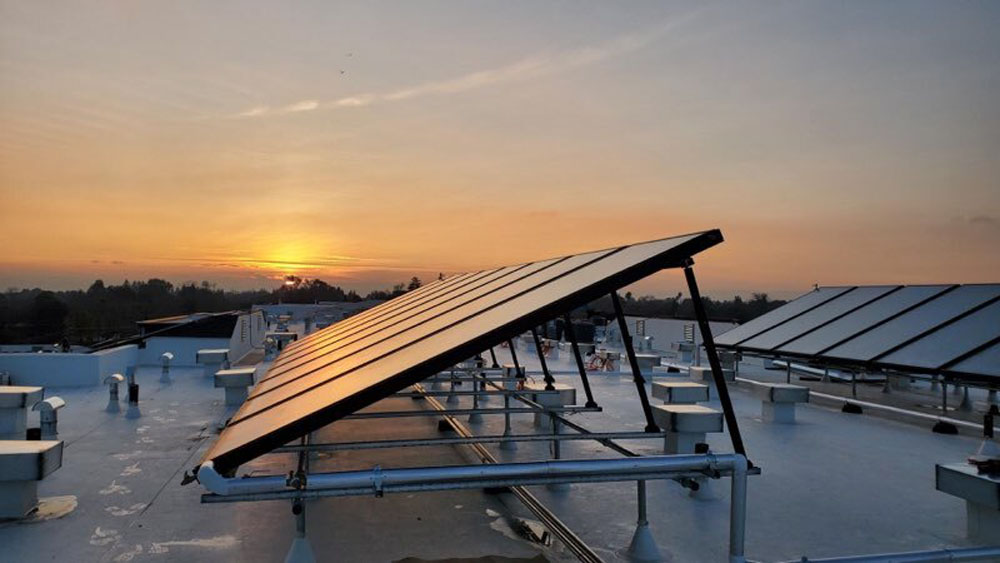
Commercial Hot Water is an Energy Strategy
Buildings with meaningful hot water demand have an energy decision to make: how that heat is generated, stored, controlled, and delivered.
SunEarth designs and manufactures commercial solar thermal systems that help reduce conventional energy use while supporting reliable, long-term hot water performance. From multifamily and hospitality to healthcare, food service, agriculture, and process applications, our systems are engineered around the load, not a one-size-fits-all solution.
Since 1978, SunEarth has helped commercial project teams turn solar energy into usable heat.


Does Your Building Have the Right Load?
Solar thermal delivers the greatest value where hot water demand is consistent, significant, and part of everyday operations.
As energy costs rise and environmental concerns grow, businesses are turning to renewable energy to manage expenses and reduce their carbon footprint. SunEarth’s solar hot water systems and high-performance solar thermal collectors offer a cost-effective, long-term solution for organizations looking to improve efficiency while maintaining operational excellence.
Multifamily communities, hotels, hospitals, food service facitlities, agriculture, laundries, and industrial or process applications are natural candidates because hot water isn't an occasional need, it's an ongoing energy load.
SunEarth systems are designed around that demand, integrating solar thermal collectors, storage, controls, and existing water-heating equipment to reduce conventional energy use while maintaining reliable hot water performance.
Solar Thermal and Heat Pumps: Why Commercial Hot Water Needs a More Complete Energy Strategy
New research reinforces an important finding from earlier California modeling: commercial water-heating performance depends on more than equipment efficiency. Heat sources, thermal storage, electrical demand, and system design all matter.
As commercial buildings move toward electrification, heat-pump water heaters are becoming an increasingly important part of the conversation. Their ability to transfer heat using electricity makes them a valuable option for reducing reliance on fossil fuels.
But electrifying water heating introduces another question: How much electricity will a building need, and when will it need it?
For facilities with substantial hot-water demand, equipment selection affects more than annual energy consumption. It can influence peak electrical demand, utility costs, infrastructure requirements, and long-term system performance.
Solar thermal offers a different approach. By converting sunlight directly into useful heat, solar water-heating systems can contribute to a building's thermal demand without relying on electricity as the primary energy source for heat generation.
Research published in 2026, together with an extensive California analysis from 2020, highlights why these technologies deserve to be evaluated as components of a complete heating strategy rather than competing solutions.
What California Research Revealed About Water-Heating Electrification
In November 2020, J.R. Plaisted of Flagstaff Research published Assessment of GHG Reduction Technologies for Water Heating Electrification in California.
The analysis evaluated solar water heating, heat-pump water heaters, solar photovoltaics, and selected combinations of these technologies across all 16 California climate zones and 14 utility tariffs.
The study considered residential water heating, multifamily central hot-water systems, and commercial pool heating. Its objective was to evaluate greenhouse gas reductions, operating costs, electrical demand, and the economics of different approaches.
For multifamily water heating, the modeled statewide averages revealed meaningful differences between solar thermal and heat-pump configurations.
| Performance measure | Solar water heating with electric backup | Heat-pump water heating |
|---|---|---|
| Greenhouse gas reduction | 90% | 81% |
| Average annual utility-bill savings | $1,743 | $349 |
| Summer peak-period electricity consumption | 51 kWh | 1,121 kWh |
Source: Flagstaff Research, November 2020, Table 1. Results represent the study's modeled California configurations, utility rates, and emissions assumptions, not current operating guarantees.
The findings did not suggest that solar thermal was the appropriate choice for every project.
Solar water-heating systems carried higher initial installed costs in the modeled configurations. The economics also varied by climate, utility territory, and building application.
What the study demonstrated was that reducing greenhouse gas emissions and reducing electrical demand are related, but distinct, objectives.
A system can substantially reduce emissions while still introducing significant electrical consumption during periods when the grid is under pressure.
Direct solar heat can change that equation.
Why Peak Electrical Demand Matters
Water heating is often evaluated in terms of annual energy consumption. Yet commercial buildings must also account for when that energy is consumed.
A facility may have sufficient annual electrical capacity on paper while facing constraints during peak operating periods.
The 2020 California analysis examined electricity consumption during summer utility peak hours, generally between 4:00 and 9:00 p.m.
Its modeling showed that solar water-heating systems with thermal storage used substantially less electricity during those periods than the heat-pump configurations evaluated.
The reason is straightforward: solar thermal systems can collect heat during daylight hours and retain it in storage for later use.
This allows a properly designed system to meet some hot-water demand without requiring equivalent electrical input at the time the water is used.
The implications can extend beyond energy savings. For suitable projects, reducing peak electrical requirements may help limit additional infrastructure demands or exposure to certain utility charges.
These outcomes depend on the building's actual load, storage design, backup equipment, utility tariff, and operating strategy.
New Research Examines Solar-Assisted Heat-Pump Performance
More recent research is examining how solar energy and heat pumps can work together.
In October 2026, pv magazine reported on experimental research involving a 10 kW dual-source CO₂ heat pump developed by Italian researchers.
The system was designed to draw heat from either ambient air or photovoltaic-thermal (PVT) collectors, selecting its operating source according to environmental conditions.
Across 307 tests, the researchers evaluated how changing solar irradiance and other conditions affected system performance.
Under the reported test conditions, increasing solar irradiance from 322 to 904 W/m² produced a 21.1% increase in heating capacity and an 18.7% improvement in coefficient of performance.
The researchers also found that air-source operation could be preferable during periods of low solar availability.
These results apply to the specific experimental system and should not be interpreted as a universal efficiency improvement for solar-assisted heat pumps.
They also illustrate an important technological distinction.
PVT collectors combine photovoltaic electricity generation and thermal collection. In this experimental configuration, they served as an alternative heat source for the heat pump.
Conventional flat-plate solar thermal collectors operate differently, capturing sunlight to deliver useful heat through a solar thermal circuit.
The technologies are not interchangeable, and their integration requirements differ.
Nevertheless, the research reinforces a broader engineering principle: the performance of a heating system depends on how its energy sources are selected and managed under changing conditions.
Solar Thermal and Heat Pumps Can Serve Complementary Roles
The possibility of combining these technologies is not new.
The 2020 Flagstaff Research analysis examined solar water heating with heat-pump backup for commercial pool applications and discussed additional opportunities to integrate solar thermal, heat pumps, and storage.
In its modeled commercial pool-heating configurations, solar thermal paired with heat-pump backup achieved an 89% reduction in greenhouse gas emissions compared with the study's gas-heating baseline.
The report also identified the potential to use thermal storage and heat-pump operation strategically to improve system economics and manage electricity demand.
Not all of the proposed combinations were fully modeled, and their practical benefits require project-specific evaluation.
Still, the findings point toward a useful approach to commercial heating design.
Solar thermal can provide direct renewable heat when solar resources and thermal demand are suitable.
Heat pumps can supply heat under different operating conditions and may serve as primary or supplementary equipment.
Thermal storage can help manage differences between heat availability and demand.
Controls coordinate system operation according to temperatures, operating requirements, and available heat sources.
The goal is not necessarily to install every technology.
It is to determine which configuration best serves the application.
Start With the Building's Thermal Load
Before selecting equipment, engineers should establish how the building uses hot water.
That evaluation should include:
-
Demand: How much hot water is required daily, and when do peak loads occur?
-
Temperature: What supply and storage temperatures does the application require?
-
Infrastructure: What electrical, mechanical, and rooftop capacity is available?
-
Existing equipment: Can current water-heating equipment remain part of the system?
-
Storage: How much useful thermal energy must be retained between generation and demand?
-
Controls: How will the system respond to changing temperatures, heat availability, and operating conditions?
-
Economics: How do installed cost, maintenance, energy rates, and long-term operation affect the decision?
A multifamily building with consistent domestic hot-water demand presents different design considerations than a school, hotel, aquatic facility, or industrial operation.
Even facilities with similar annual hot-water consumption may require substantially different system configurations.
Understanding the load is therefore more valuable than beginning with a predetermined equipment choice.
Thermal Storage Is Part of the Energy Strategy
Storage is particularly important when renewable heat is available at different times from the building's demand.
Solar thermal systems can collect energy during periods of sunlight and store useful heat for subsequent consumption.
The effectiveness of that storage depends on more than tank volume.
Engineers must consider operating temperatures, usable stored energy, heat losses, recovery requirements, heat-exchanger performance, and the interaction between generation and backup equipment.
The same principles become important when heat pumps and other heating technologies are integrated into a common system.
A properly engineered storage configuration can support reliable hot-water delivery while providing flexibility in when and how heat is generated.
Controls Help Connect Generation, Storage, and Delivery
As commercial hot-water systems incorporate multiple components, controls become increasingly important.
Temperature sensing, circulation management, and operating sequences influence how effectively available heat is captured, stored, and delivered.
Modern solar thermal controls support the management of solar collection and system operation.
More complex hybrid configurations may require additional equipment and supervisory control strategies to coordinate different heat sources.
Control capability should always be evaluated against the requirements of the actual system.
This is why a complete design approach matters.
Individual equipment specifications cannot, by themselves, determine how an integrated installation will perform.
A More Complete Approach to Commercial Renewable Heat
The 2020 California modeling and 2026 experimental research examine different technologies, applications, and performance measures.
They should not be treated as directly comparable studies.
Together, however, they support an important conclusion: commercial water-heating decisions benefit from evaluating the complete thermal system.
Electrification can reduce greenhouse gas emissions.
Direct solar heat can contribute renewable thermal energy while reducing dependence on electricity for suitable loads.
Thermal storage can help separate heat generation from the timing of demand.
And properly selected controls can support coordinated system operation.
For building owners and engineers, the opportunity is to evaluate these capabilities together rather than assuming a single technology will always provide the best outcome.
Manufactured. Engineered. Supported.
For more than 40 years, SunEarth has manufactured solar thermal equipment for residential and commercial applications.
Our approach considers the complete thermal system:
Generate. Store. Control. Deliver.
From solar thermal collectors and storage solutions to system controls and engineering support, SunEarth helps customers evaluate practical ways to incorporate direct renewable heat into their projects.
Whether designing a new commercial hot-water system, evaluating an existing installation, or exploring opportunities to integrate renewable heat with other technologies, the starting point remains the same:
Understand the load. Evaluate the available heat sources. Engineer the system around the application.
Planning a commercial hot-water project? Contact SunEarth to discuss your thermal requirements and system options.
Research References
-
Plaisted, J.R. (2020). Assessment of GHG Reduction Technologies for Water Heating Electrification in California. Flagstaff Research, November 2020. See especially the summary findings, multifamily analysis, commercial pool-heating analysis, and Section 8 on technology integration.
-
Applied Thermal Engineering (2026). Research on experimental dual-source air/PVT CO₂ heat-pump performance and operating-mode selection, reported by pv magazine, October 22, 2026.
Editorial note: The 2020 findings are historical modeling results. The 2026 findings concern an experimental PVT-assisted heat pump. Neither study establishes performance guarantees for SunEarth products or a particular commercial installation.
Industries We Serve
Our commercial solar water heating solutions are ideal for:
- Hotels & Resorts – Reliable hot water for guests while lowering energy costs.
- Apartments & Multi-Family Housing – Cost-efficient heating for high-demand buildings.
- Hospitals & Healthcare Facilities – Sustainable energy solutions for critical operations.
- Restaurants – Hot water solutions designed for kitchens and food service operations.
- Gyms, Spas & Fitness Centers – Consistent hot water for showers, pools, and wellness facilities.
- Wineries & Breweries – Energy-efficient solutions for production and processing needs.
- Laundromats & Laundry Facilities – Scalable systems for high-volume water heating.
- Government & Military – Durable and reliable solutions for public sector facilities.
- Car Washes – Reduce energy costs with high-efficiency solar hot water.
- Schools & Universities – Scalable systems for educational institutions, from small schools to large campuses.
- Food Processing Centers – Efficient hot water solutions for meeting production demands and maintaining quality control.
- Greenhouse – Reliable heating systems to optimize growing conditions and enhance plant health.
- Agriculture – Sustainable energy solutions for irrigation and processing operations.
- Dairy Farms – Cost-effective heating for milk processing and equipment sanitation.

Explore the System
Every commercial hot-water project is different. SunEarth provides the core components needed to build a complete solar thermal system around the application, load, storage requirements, and existing mechanical infrastructure.
Explore the technologies that capture, move, store, and control renewable heat.
- Flat Plate Solar Collectors – High-efficiency, durable solar thermal collectors.
- Controllers & Pumps – Optimized for seamless system performance.
- Storage Tanks – Engineered for maximum efficiency and longevity.
- Innovative Pre-Engineered Solar Stations
- SolarStation XL – Designed for commercial applications up to 720 ft² of collector area, factory-assembled and tested for hydraulic integrity.
- SolarStation XXL – Engineered for large-scale systems over 720 ft², featuring multi-speed pumps for compatibility across various configurations.
Store the Heat. Use it when it Matters.
Solar thermal doesn't have to produce heat at the exact moment hot water is needed. Thermal storage allows captured solar energy to be held as heated water and used as building demand changes throughout the day.
Properly sized storage helps align solar production with hot-water demand, supports system performance, and gives commercial facilities greater flexibility in how renewable heat is used.
SunEarth offers commercial solar storage solutions designed to integrate with complete solar thermal systems and existing hot-water infrastructure.
Discover our Solar Tanks to see how they can benefit your operations, reduce energy costs, and support sustainability goals.
Benefits of SunEarth's Hot Water Storage:
- Match production to demand - store renewable heat for use beyond peak solar hours.
- Support system performance - properly sized storage helps the collector field operate effectively.
- Integrate with existing equipment - storage can work alongside conventional backup water heating.
- Design around the load - tank volume and configuration should reflect actual building demand, not a one-size-fits-all formula.
Explore our solar hot water storage solutions today to learn how they can enhance your commercial systems.
Measured Heat Matters
Larkspur Commons | Bozeman, Montana
At Larkspur Commons, hot water was treated as an energy strategy from the start. The 136-unit affordable housing community uses 16 solar thermal systems equipped with SunEarth EC-40 collectors to preheat domestic hot water before it reaches each apartment's conventional water heater.
The 4,000-square-foot solar hot-water installation now supplies 60–75% of the property's annual hot-water demand, demonstrating what renewable heat can contribute when a building has a large, consistent thermal load.

Design. Documentation. Compliance.
Commercial solar thermal projects require more than equipment. SunEarth supports engineers, contractors, developers, and building owners with certified products, performance documentation, design resources, and project-specific technical guidance to help move projects from design through permitting and installation.
For California projects, SunEarth also supports compliance with the California Energy Code - Title 24, Part 6 - including solar water heating documentation and performance-based compliance strategies where applicable.
Project Support Includes:
- ICC-SRCC - OG-100 certified collectors and OG-300 certified systems
- ENERGY STAR certified solar water heating system options
- Support for Title 24 prescriptive and performance compliance pathways, where applicable
- Performance data and documentation for use with approved energy-modeling tools
- CAD, Revit, specifications, submittals, and technical design resources specifications, submittals, and technical design resources
- Project-specific guidance for multifamily, hospitality, institutional, public-sector, and commercial applications
For California Projects
Solar water heating can be incorporated into Title 24 compliance strategies where applicable. SunEarth provides the performance ratings, certifications, system documentation, and technical support project teams need to evaluate solar thermal within the building’s overall energy design.
Documentation & Support Available:
- Specification sheets
- SRCC third-party performance ratings and certifications
- Integration details for compliance software
- Design assistance and value engineering options
Why SunEarth?
Commercial renewable heat requires experience across the entire system.
Since 1978, SunEarth has designed and manufactured solar thermal equipment for residential and commercial applications. Our approach extends beyond the collector - from system components and storage to controls, technical resources, and project support.
We help project teams design around the load, integrate with existing infrastructure, and build systems for reliable long-term performance.
- Industry Expertise Since 1978 – Over four decades of leadership in solar thermal innovation.
- Proven Performance – Longest-lasting, low-maintenance solar water heating systems in the industry.
- Custom Solutions – Tailored designs for commercial, industrial, and institutional applications.
- Cost Savings & Sustainability – Reduce utility bills while supporting clean energy initiatives.
Let's Talk About the Load
Tell us what you're heating, where the project is located, and where you are in the design process. We'll help determine whether solar thermal belongs in the strategy.
Commercial Solar Thermal FAQ
Solar thermal is a strong fit for buildings with consistent, year-round hot water demand. Common applications include multifamily housing, hotels, hospitals, food service, laundries, agriculture, campuses, and industrial or process facilities.
Start with the load. Daily hot water use, operating hours, occupancy, incoming water temperature, and required delivery temperature all help determine whether solar thermal is a good fit. SunEarth can help evaluate project conditions and system requirements.
Not necessarily. Commercial solar thermal systems are often designed to preheat water before it reaches conventional water-heating equipment. The existing boiler, water heater, or other backup system remains available when additional heat is required.
Yes. Solar thermal can be integrated with a variety of conventional and high-efficiency water-heating technologies. The system design depends on the application, existing mechanical infrastructure, storage strategy, and project goals.
Commercial systems are typically designed with backup water heating so hot water remains available regardless of solar conditions. Solar thermal reduces the amount of energy the backup equipment must provide rather than eliminating the need for backup altogether.
Storage is sized around the collector array, hot water load, operating schedule, and system configuration. Proper storage helps align solar heat production with building demand and supports overall system performance.
System performance can be evaluated using temperature sensors, flow measurement, BTU metering, controls, and monitoring equipment. These tools can help project teams understand renewable heat production, system operation, and long-term performance.
Helpful information includes the project location, building type, daily hot water demand, required water temperatures, existing water-heating equipment, available roof or ground area, project stage, and any available plans or specifications.


