
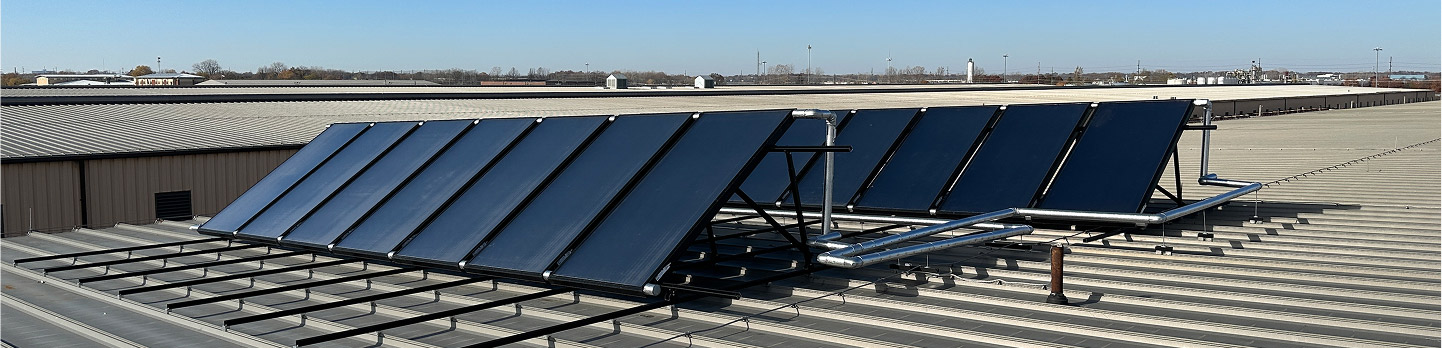
Commercial Hot Water Is an Energy Strategy
Commercial hot water is often treated as a plumbing decision.
What size equipment is required?
What needs to be replaced?
How much storage fits in the mechanical room?
What does the budget allow?
Those questions still matter.
But they are no longer enough.
For buildings with significant domestic hot water, laundry, kitchen, pool, sanitation, or process-water demand, hot water affects operating costs, infrastructure decisions, energy use, controls, maintenance, and long-term building performance.
That makes commercial hot water more than an equipment category.
It is an energy strategy.
October brought the conversation into sharper focus
This month, SunEarth moved through two important industry conversations.
At the 2026 ASPE Convention & Expo, the focus was plumbing engineering, system design, domestic hot water performance, storage, equipment selection, and the practical decisions that shape how commercial buildings deliver hot water every day. ASPE describes the 2026 event as a gathering for plumbing industry professionals at the Oklahoma City Convention Center, with programming around plumbing engineering, sustainable design, and industry innovation.
At the Renewable Thermal Collaborative Summit, the lens widened. The RTC Summit brings together large industrial, institutional, and commercial energy users to accelerate renewable thermal solutions and overcome deployment challenges.
Those audiences may approach the issue from different starting points, but they point toward the same conclusion:
Commercial hot water is not just a plumbing decision. It is part of the building’s energy strategy.
That is the bridge SunEarth carries forward from ASPE and RTC toward AHR Expo in Chicago.
Equipment replacement is only one part of the decision
An aging water heater or underperforming hot water plant naturally creates a replacement conversation.
But replacement should not be the whole conversation.
A commercial hot water decision should also consider the building’s actual hot water use, timing of demand, storage requirements, controls and monitoring, backup equipment, available roof or ground space, mechanical-room constraints, existing infrastructure, operating cost exposure, commissioning, and long-term support.
This broader view is becoming more important as commercial water-heating equipment receives more regulatory and market attention. The U.S. Department of Energy defines commercial water-heating equipment to include commercial storage water heaters, commercial instantaneous water heaters, hot water supply boilers, and unfired hot water storage tanks. DOE’s amended energy conservation standards require compliance for covered commercial water-heating equipment manufactured on or after October 6, 2026.
DOE has also issued an enforcement policy stating that it will delay enforcement activity for certain gas-fired commercial water-heating categories manufactured on or after October 6, 2026, but before October 6, 2027.
That does not mean every building needs the same answer.
It means the decision point deserves a more complete conversation.
Operating cost belongs in the strategy
First cost will always matter.
But commercial hot water systems do not stop costing money once equipment is installed.
They continue to affect utility bills, fuel or electricity exposure, maintenance, replacement planning, service calls, downtime risk, and long-term system performance.
That is why commercial solar thermal changes the discussion.
Solar thermal is not simply another piece of equipment. In the right application, it can reduce the amount of conventional energy required to produce hot water.
That distinction matters.
The question is not always:
Can renewable heat replace the entire water-heating plant?
The better question is:
Can renewable heat reduce how much conventional energy this building needs to use for hot water?
That framing allows solar thermal to be evaluated alongside storage, backup equipment, controls, commissioning, and the building’s actual operating profile.
Measured heat is more useful than installed equipment
If commercial hot water is an energy strategy, performance needs to be visible.
A system that cannot be measured is easy to ignore. A system that can be monitored is easier to evaluate, maintain, troubleshoot, and improve.
That matters because renewable heat should not operate like a black box.
Engineers, contractors, facility teams, and building owners need to understand whether heat is being collected, stored, moved, and delivered as intended.
Performance visibility turns solar thermal from installed equipment into an operating asset.
Larkspur Commons shows what measured renewable heat can look like
SunEarth’s Larkspur Commons project in Bozeman, Montana shows why measured performance matters.
The affordable housing development includes a 4,000-square-foot solar hot water system made up of 16 solar thermal systems using SunEarth EC-40 collectors. Each system includes 216 gallons of storage capacity. SunEarth reports 8,631 kWh of annual energy output per system, monthly BTU-meter readings on the solar controls, and a solar contribution equal to 60% to 75% of annual hot water demand.
Those figures matter because they move the conversation beyond equipment installed.
They show renewable heat being tied to a real building application, a recurring hot water load, and performance that can be read and tracked.
That is the kind of proof commercial hot water strategy needs more often.
Not just what was installed.
What it is producing.
Existing infrastructure is part of the energy strategy
Not every energy strategy begins with new equipment.
Many buildings already have useful infrastructure on-site: storage, piping, pumps, controls, heat exchangers, collector space, mechanical-room layouts, or even older solar thermal systems that are offline or underperforming.
Those assets should not be dismissed without review.
SunEarth’s work at Hyatt Regency Scottsdale Resort & Spa at Gainey Ranch demonstrates this point. The project focused on restoring and recommissioning an existing solar thermal system and returning renewable heat infrastructure to service.
The Hyatt project should not be framed around savings numbers SunEarth has not published.
Its value is different.
It shows that commercial solar thermal can be treated as long-term infrastructure - something to evaluate, modernize, support, and return to productive operation when the building still has meaningful hot water demand.
That is asset management.
That is energy strategy.
Electrification makes hot water planning more important
Electrification is an important part of building decarbonization.
But it also makes planning more important.
ASHRAE notes that electrification can significantly increase electrical demand and may require additional infrastructure at both the building and grid distribution level. ASHRAE also points to energy efficiency, energy storage, demand flexibility, grid-interactive controls, integrated design, commissioning, and operations training as strategies that can support better building decarbonization outcomes.
That guidance reinforces the need for load-specific thinking.
Some building loads may be best electrified.
Some may be reduced through efficiency.
Some may be supported with storage.
Some may be served directly with renewable heat.
For commercial hot water, the strategic question is not whether one technology wins.
The better question is:
Which mix of technologies best serves this building’s heat demand, infrastructure, operating goals, and long-term cost exposure?
Carrying the conversation toward AHR Expo
With ASPE Expo and the RTC Summit complete, SunEarth’s next major industry moment is AHR Expo 2027 in Chicago.
That shift matters.
ASPE kept the conversation close to plumbing design and domestic hot water performance. RTC widened the lens to renewable thermal strategy and the role of heat in commercial, institutional, and industrial energy planning. AHR brings those conversations together inside the broader mechanical-systems environment - where heating, controls, building performance, energy efficiency, and long-term operation all intersect. AHR Expo 2027 is scheduled for January 25–27, 2027 at McCormick Place in Chicago.
For SunEarth, that is the right place for the next phase of the commercial hot water conversation.
The industry does not need another reminder that buildings use hot water.
It needs better ways to evaluate how that heat is produced, stored, measured, managed, and supported over time.
That means moving from installed equipment to measured performance.
From one-time replacement decisions to long-term operating strategy.
From invisible systems to controls and visibility.
From single-technology conversations to a more practical understanding of where renewable heat belongs.
SunEarth’s work at Larkspur Commons helps show what that can look like when renewable heat contribution is measured and tied to a real building load. The Hyatt Regency Scottsdale project shows why existing solar thermal infrastructure should not be dismissed without review.
Together, those examples point toward the same conclusion.
Commercial hot water is not just something a building consumes.
It is energy that can be generated, stored, measured, managed, and optimized.
The takeaway
Commercial hot water is an energy strategy because it affects how a building uses energy every day.
It affects operating costs, infrastructure decisions, equipment selection, controls, maintenance, and long-term performance. It also affects how renewable heat can be evaluated as part of a building’s broader energy plan.
For buildings with meaningful hot water demand, solar thermal can be part of that strategy when it is matched to the right application and supported as an operating system.
As SunEarth looks ahead to AHR Expo in Chicago, the conversation continues to move beyond equipment alone.
The better question is not simply what a building uses to make hot water today.
The better question is how that heat should be produced, stored, measured, managed, and supported for the years ahead.
Generate. Store. Measure. Manage.
SunEarth works with engineers, contractors, distributors, facility teams, and building owners to evaluate commercial hot water demand, solar thermal opportunities, storage, pump stations, controls, retrofit integration, and recommissioning needs.
With ASPE and RTC complete, SunEarth is carrying the commercial renewable heat conversation forward into AHR Expo 2027 in Chicago.
If your project includes significant domestic hot water, laundry, kitchen, pool, sanitation, or process-water demand, now is the time to treat hot water as part of the building’s energy strategy.
Connect with SunEarth to discuss where renewable heat fits into your next commercial project.