
Colorado Opens New Industrial Decarbonization Funding Opportunities: Where Renewable Heat Fits
Colorado's latest industrial emissions-reduction funding round gives manufacturers and facility operators another reason to evaluate how process heat, hot water, and existing mechanical systems contribute to energy consumption.
Colorado is continuing its investment in industrial decarbonization, creating opportunities for facilities to evaluate technologies that reduce emissions and improve energy performance.
In October 2026, the Colorado Energy Office announced $13.9 million in awards through its Clean Air Program and Colorado Industrial Tax Credit Offering (CITCO). The state has also opened additional funding opportunities for qualifying industrial emissions-reduction projects.
The current Clean Air Program application window closes November 20, 2026, while the CITCO application cycle runs through December 31, 2026.
For industrial facilities, the funding conversation raises an important engineering question: How much of a facility's energy demand is used to produce heat, and which portions could be supplied more efficiently?
Industrial decarbonization starts with understanding the load
Manufacturing facilities, food processors, laundries, and other commercial operations frequently require hot water or thermal energy for cleaning, sanitation, production, and building services.
These demands are not identical. Operating temperatures, daily schedules, peak usage, and existing equipment all influence which technologies may be practical.
Before selecting a decarbonization strategy, facility operators should evaluate:
-
The temperatures and volumes required by each process.
-
When thermal demand occurs throughout the day.
-
Existing boiler, water-heating, and storage infrastructure.
-
Available space and solar exposure.
-
Opportunities to reduce fuel or electricity consumption without disrupting operations.
This load-first approach can identify where energy efficiency improvements, heat recovery, electrification, renewable heat, or combinations of technologies deserve further investigation.
Where solar thermal enters the conversation
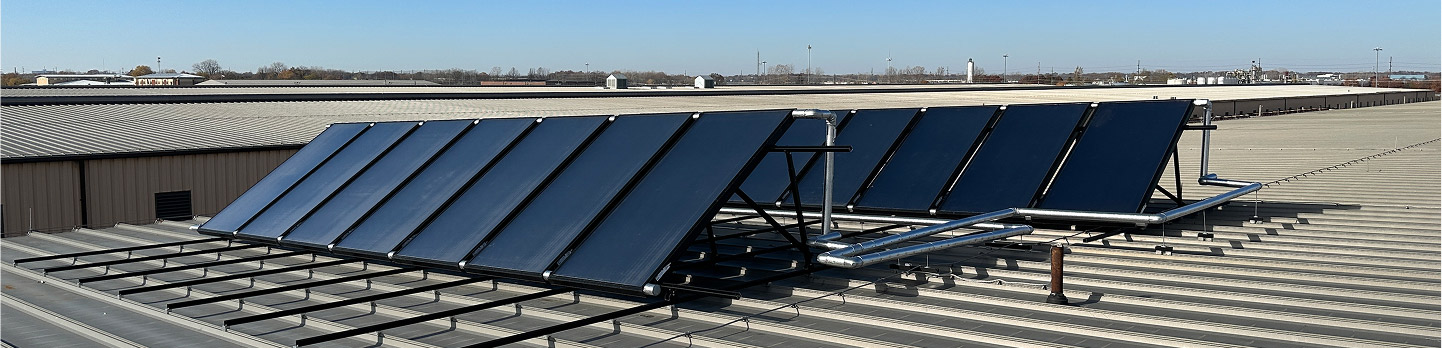
Solar thermal systems collect sunlight and convert it directly into usable heat. For suitable applications, that heat can preheat water or supply part of a process's thermal demand before auxiliary heating equipment provides any remaining energy.
When integrated with appropriately sized storage and controls, solar thermal can complement existing mechanical systems rather than requiring wholesale equipment replacement.
SunEarth manufactures solar thermal collectors, storage and pumping solutions, and controls for residential and commercial applications. Its technologies can be evaluated as part of broader strategies to reduce conventional water-heating energy demand.
Funding eligibility is project-specific. Colorado's industrial programs have distinct applicant, technology, emissions-reduction, and documentation requirements. The existence of these programs does not establish that a particular solar thermal installation qualifies.
Preparing for a funding conversation
For project teams considering industrial energy improvements, the first step is to document the facility's existing thermal demand, operating conditions, energy consumption, and proposed equipment changes.
Those details help determine whether a renewable-heat strategy is technically appropriate and whether it aligns with an available funding program.
Colorado's current funding opportunities reinforce a larger point: industrial decarbonization is not solely an electricity question. Heat deserves an equally rigorous engineering evaluation.
Evaluating industrial hot water or process heat? Contact SunEarth to discuss solar thermal integration, storage, and system design.
Program resources
Funding availability, deadlines, eligibility, and award decisions are determined by the administering agency. Applicants should verify current requirements directly before submitting a proposal.