
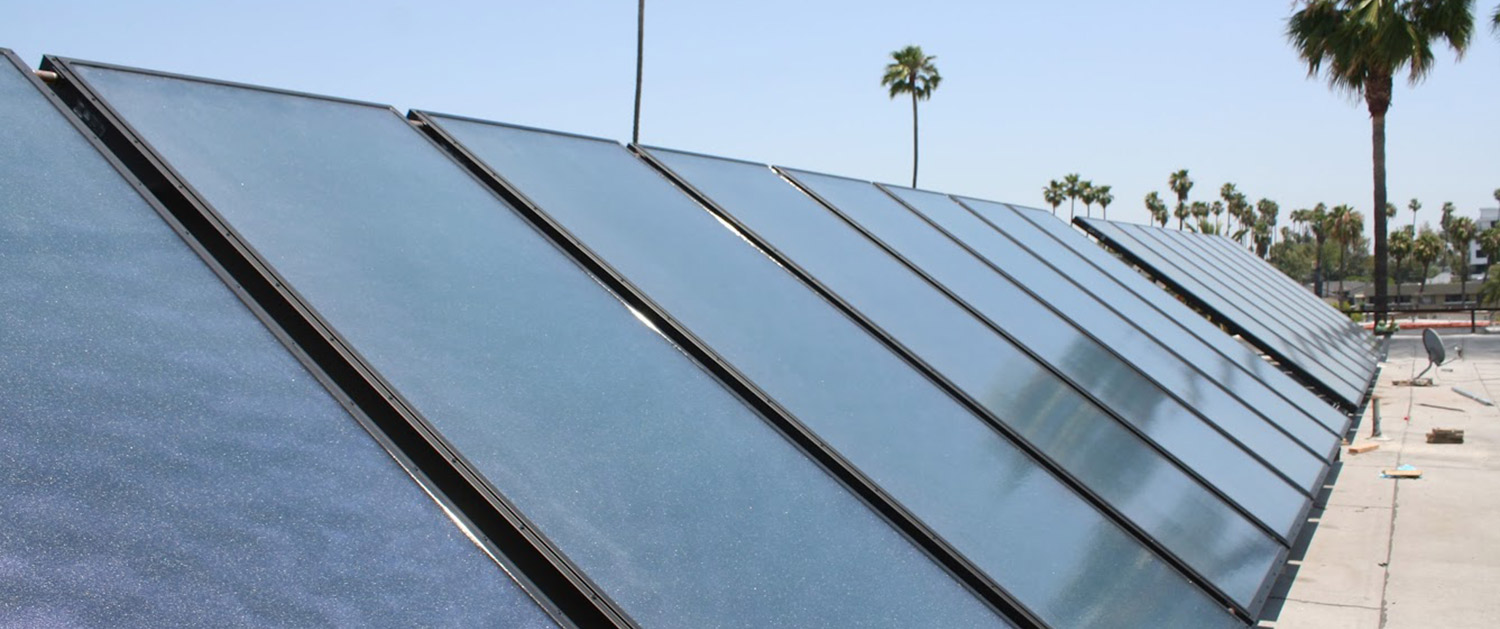
Larkspur Commons: Solar Thermal Meets 60–75% of Annual Hot Water Demand

Bozeman, Montana | Multifamily Affordable Housing
60–75% of Annual Hot Water Demand
At Larkspur Commons, hot water was treated as an energy strategy from the start.
The 136-unit affordable housing community in Bozeman, Montana, was designed with a 4,000-square-foot solar hot water installation consisting of 16 separate solar thermal systems. Each system uses SunEarth EC-40 collectors and 216 gallons of thermal storage to preheat domestic hot water before it reaches the apartments’ conventional water-heating equipment.
Project performance records report that solar thermal provides 60–75% of annual hot water demand, demonstrating the value of renewable heat in buildings with large, consistent domestic hot water loads.
Project at a Glance
136
Residential units
4,000 FT²
Solar hot water collector area
16
Solar thermal systems
216 GAL
Thermal storage per system
SUNEARTH EC-40
Solar thermal collectors
BTU METERED
System performance monitoring
Why the Load Mattered
Multifamily housing is a natural fit for solar thermal because hot water demand is consistent, recurring, and closely tied to everyday building operations.
At Larkspur Commons, showers, sinks, kitchens, laundry, and other domestic uses create a dependable thermal load throughout the year. Rather than treating that demand simply as another electrical or fuel load, the project team incorporated solar thermal to generate a significant portion of the heat directly.
That distinction matters.
Solar thermal performs especially well where a building has substantial, predictable hot water demand and the opportunity to store renewable heat for later use.
How the System Works
The Larkspur Commons installation is made up of 16 independent solar hot water systems serving groups of apartments throughout the development.
SunEarth EC-40 collectors capture solar energy as heat.
That heat is transferred into dedicated thermal storage, with 216 gallons of storage capacity per system.
Solar-heated water then preheats the domestic hot water supply before it reaches each apartment’s conventional water heater.
The conventional equipment remains available to provide additional heat when needed, while solar thermal reduces the amount of energy required from the backup system.
The result is an integrated hot water strategy rather than an either-or equipment decision.
More Than Collectors
The Larkspur Commons project demonstrates why commercial solar thermal is about more than equipment on a roof.
A successful system must capture heat, move it through the building, store it until it is needed, control system operation, and integrate with existing hot water infrastructure.
At Larkspur Commons, those elements work together as a complete thermal-energy system designed around the building’s load.
Capture. Store. Control. Deliver.
Measured Heat Matters
Renewable heat becomes far more useful when its contribution can be measured.
The Larkspur Commons systems were designed with controls that allow project teams to monitor thermal performance through BTU metering and system data.
Project records report that the installation supplies approximately 60–75% of annual domestic hot water demand.
That number is what matters.
Not simply how many collectors were installed.
Not simply how much roof area was used.
But how much of the building’s actual hot water load renewable heat was designed to serve.
A Different Role for Solar
Larkspur Commons incorporates both solar thermal and solar electric technologies, but they were designed to serve different building loads.
The solar electric system supports electrical demand.
The much larger solar hot water installation was designed around the community’s significant and consistent need for domestic hot water.
That is an important distinction for commercial project teams.
The goal does not have to be choosing one renewable technology over another. The stronger energy strategy is often identifying the load first, then selecting the technology best suited to serve it.
For a building with substantial hot water demand, renewable heat deserves its own place in that conversation.
Why It Matters for Multifamily Projects
For multifamily owners, developers, engineers, and facility teams, domestic hot water represents an ongoing operating load.
Solar thermal can help address that load without requiring the building to produce every unit of thermal energy through conventional water-heating equipment.
Projects like Larkspur Commons show what is possible when solar thermal is incorporated into the hot water strategy:
- Reduced dependence on conventional water-heating energy
- Renewable heat generated directly at the building
- Thermal storage that helps align solar production with hot water demand
- Integration with existing or backup water-heating equipment
- Measurable thermal performance
- Long-term renewable energy contribution in a high-use application
Does Your Building Have the Right Load?
Commercial solar thermal delivers the greatest value where hot water demand is meaningful, consistent, and part of everyday operations.
Multifamily communities, hotels, hospitals, laundries, food service facilities, agriculture, campuses, and industrial or process applications may all have thermal loads worth evaluating.
The first question is not how many collectors you need.
It is:
What are you trying to heat?
SunEarth can help evaluate the load, existing infrastructure, storage requirements, available installation area, and project goals to determine where solar thermal fits.
Project Summary:
- Location: Bozeman, MT
- Application: Solar water heating for affordable housing complex (8 buildings; 150 apartments)
- Solar Collectors: Sun Earth EC40
- System Format: Solar pre-heated water for tenants' water heaters
- Storage Capacity: 16 solar thermal systems; Each with 216 gallons of storage
- Rated Power Output: 13.30 kW (per system)
- Yearly Energy Output (kWh): 8,631 kWh (per system)
- Metering: Monthly readings of BTU metering on solar controls
Contact Information:
- SunEarth: www.sunearthinc.com
- Liquid Solar Systems: https://liquidsolarsystems.com