
Better Hot Water Starts With Better Questions
Commercial hot water design should not start with a product list.
It should start with the building.
How much hot water does it use?
When does demand happen?
What temperature is required?
How will heat be stored and moved?
Where does renewable heat fit?
For commercial buildings with significant domestic hot water, laundry, kitchen, pool, sanitation, or process-water demand, those questions matter. Hot water is not a small side load. It is part of how the building operates every day.
That is why better commercial hot water systems begin with better questions.
Before equipment is selected, before storage is finalized, before controls are specified, and before roof or mechanical-room space is committed, project teams need to understand the load they are designing around.
The strongest systems are not built around assumptions.
They are designed around demand.
Start with the building’s actual hot water use
Every building has a load.
But not every load creates the same opportunity.
A hotel, multifamily property, healthcare facility, restaurant, laundry, car wash, school, or industrial building may all use hot water differently. Even within the same building type, demand can vary based on occupancy, operating hours, fixture count, kitchen activity, laundry schedules, sanitation needs, pool or spa usage, and process requirements.
That is why commercial hot water planning should begin with actual use.
Project teams should ask:
- How much hot water does the building use each day?
- When are the highest demand periods?
- Is demand consistent, seasonal, or tied to operating schedules?
- Are there multiple hot water loads that should be evaluated separately?
- Is hot water tied directly to guest comfort, resident use, sanitation, production, or service delivery?
These questions help clarify whether the building has a thermal profile that deserves a more strategic review.
For buildings with meaningful and recurring hot water demand, renewable heat may belong in the conversation.
The load should shape the system
Commercial hot water is not just about capacity.
It is about how heat is produced, stored, moved, controlled, backed up, and delivered.
That means the load should shape the system design.
A building with steady daily demand may require a different strategy than one with short, intense peaks. A building with limited mechanical-room space may need a different storage approach. A building with an existing water-heating plant may be better suited for retrofit integration. A property with an inactive solar thermal system may deserve a recommissioning review before the infrastructure is written off.
The right strategy depends on the building’s conditions.
That includes:
- daily hot water volume,
- peak demand timing,
- temperature requirements,
- storage needs,
- available collector space,
- mechanical-room constraints,
- backup equipment,
- controls,
- maintenance access,
- commissioning requirements,
- operating cost goals.
When those details are understood early, solar thermal can be evaluated as part of the complete hot water strategy.
When they are ignored, the project may default to equipment replacement without fully reviewing the thermal opportunity.
Renewable heat is not an afterthought
Solar thermal is strongest when it is considered early enough to be integrated well.
That does not mean it belongs on every project.
It means that buildings with significant hot water demand should evaluate whether renewable heat can reduce the conventional energy required to meet that load.
Solar thermal can support commercial hot water strategies in several ways:
- as part of a new system,
- as renewable preheat in a retrofit,
- as a recommissioning opportunity for existing solar thermal infrastructure,
- as part of a broader energy-cost management strategy,
- as a way to address heat directly rather than treating every energy challenge as an electrical load.
The key is timing.
If renewable heat is considered only after the mechanical strategy is finalized, opportunities may be harder to integrate. Roof space may already be committed. Storage may not be planned. Controls may not be coordinated. Backup equipment may have been selected without evaluating how much conventional energy the building actually needs to use.
Better questions help prevent that.
Commercial hot water is a system conversation
A commercial hot water system is more than the equipment that produces final delivery temperature.
It includes storage, controls, pump stations, piping, valves, sensors, backup equipment, commissioning, maintenance access, and the building’s daily operating pattern.
When solar thermal is part of that system, the conversation becomes even more connected.
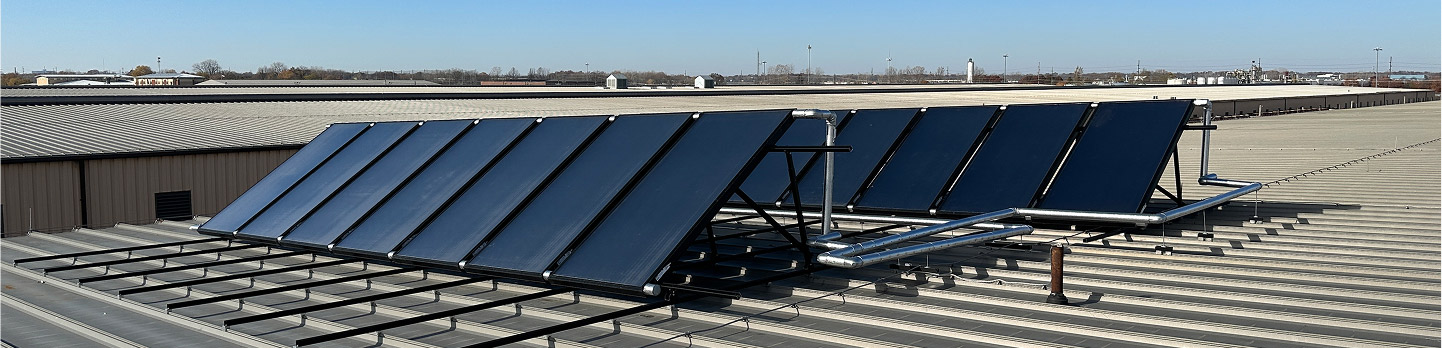
Collectors capture renewable heat. Storage helps hold that heat until the building can use it. Pump stations move heat through the system. Controls help the system respond to changing conditions. Backup equipment provides reliability when solar contribution is not enough. Commissioning helps confirm the system is operating as intended.
Each component matters.
But the value comes from how the system works together.
That is why asking better questions at the beginning can lead to better decisions throughout the project.
Better questions create better project paths
Not every commercial renewable heat opportunity starts in the same place.
Some begin with new construction, where the domestic hot water strategy is still being designed.
Some begin with retrofit opportunities in existing buildings with strong hot water demand.
Some begin with recommissioning, where existing solar thermal infrastructure may be evaluated, modernized, and returned to service.
Each path requires a different approach.
But each path begins with the same discipline: understanding the building.
For a new system, that may mean evaluating renewable heat before storage, controls, and backup equipment are finalized.
For a retrofit, it may mean reviewing existing equipment, utility use, available space, and integration points.
For recommissioning, it may mean asking whether an existing solar thermal system can be restored rather than abandoned.
The right path is not always the newest path.
It is the path that fits the building’s load, infrastructure, and long-term goals.
Existing systems deserve better questions too
Better hot water questions are not only for new projects.
They also matter when buildings already have equipment in place.
If an existing water-heating system is aging, underperforming, costly to operate, or being reviewed for replacement, that is a decision point. It is an opportunity to evaluate whether the building’s hot water strategy still fits the way the property operates today.
It is also an opportunity to look at existing renewable heat infrastructure.
Some buildings already have solar thermal systems on-site. Those systems may be offline, underperforming, undocumented, or no longer familiar to the current facility team.
That does not always mean the system has no value.
It may mean the system needs to be evaluated.
SunEarth’s recommissioning work at Hyatt Regency Scottsdale Resort & Spa at Gainey Ranch is a reminder that commercial solar thermal can be long-term infrastructure. Existing systems may be able to return to productive operation when they are properly reviewed, modernized, and supported.
Before writing off a renewable heat asset, ask better questions.
The questions project teams should bring forward
Before finalizing a commercial hot water strategy, project teams should be prepared to answer:
- What is the building’s actual hot water demand?
- When does peak demand occur?
- What temperatures are required?
- How much storage is needed?
- How will heat be moved through the system?
- What backup equipment is required?
- How will the system be controlled and monitored?
- Is there available roof, ground, or structural space for collectors?
- Is this a new system, retrofit, or recommissioning opportunity?
- What are the project’s long-term operating cost and energy-performance goals?
- Who will operate and maintain the system over time?
These questions do more than support solar thermal evaluation.
They support better commercial hot water planning.
Bringing the conversation to ASPE
As SunEarth heads to the ASPE Convention & Expo, this is the conversation we are bringing forward:
Better hot water starts with better questions.
For plumbing engineers, mechanical designers, contractors, distributors, facility teams, and building owners, commercial hot water deserves a system-level conversation. It is not just about selecting equipment. It is about understanding demand, integrating storage, coordinating controls, supporting reliability, and evaluating whether renewable heat has a role to play.
SunEarth’s focus is on helping project teams identify where solar thermal makes sense, how it fits into the broader domestic hot water strategy, and which path - new system, retrofit, or recommissioning - best fits the building.
The strongest projects start before the system is sized.
They start with the load.
The takeaway
Commercial hot water is too important to design around assumptions.
For buildings with meaningful thermal demand, the better path begins with understanding how the building actually uses hot water, when that demand occurs, what temperatures are required, how heat will be stored and moved, and where renewable heat may fit.
Solar thermal does not belong in every building.
But in the right applications, it can be a practical strategy for reducing conventional water-heating energy use and supporting long-term building performance.
The best way to find those opportunities is simple:
Ask better questions.
Start With the Load. Design for the System.
SunEarth works with engineers, contractors, distributors, facility teams, and building owners to evaluate commercial hot water demand, solar thermal opportunities, storage, pump stations, controls, retrofit integration, and recommissioning needs.
If your project includes significant domestic hot water, laundry, kitchen, pool, sanitation, or process-water demand, start the conversation before the mechanical strategy is finalized.
Connect with SunEarth to discuss how renewable heat can support your next commercial hot water project.