
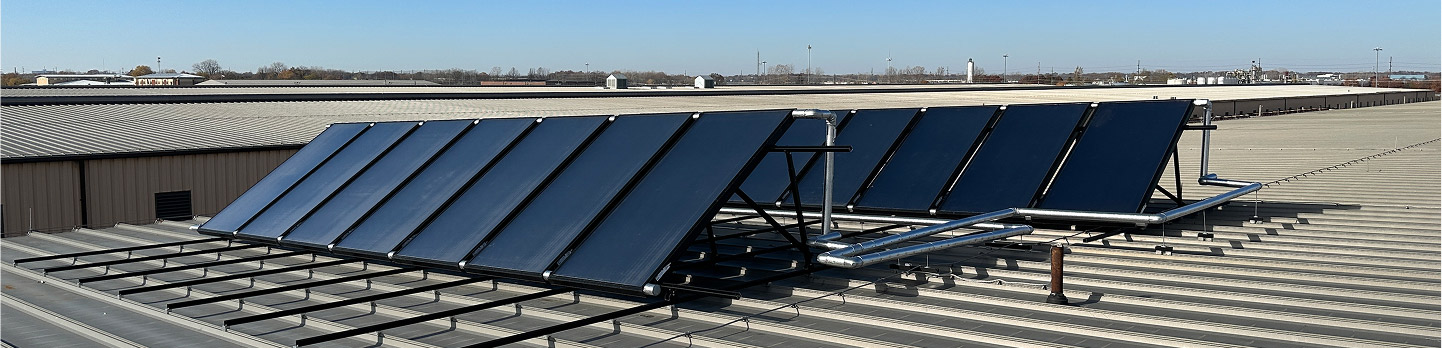
Before You Replace a Commercial Hot Water System, Ask This
When a commercial hot water system is aging, underperforming, costly to operate, or difficult to maintain, the next step can seem obvious.
Replace the equipment.
But for buildings with significant domestic hot water, laundry, kitchen, pool, sanitation, or process-water demand, replacement should not be the first question.
It should be one possible outcome of a broader review.
Before replacing a commercial hot water system, project teams should ask:
Is the current system still aligned with how the building actually uses hot water today?
That question can open the door to a better conversation — one that considers the load, storage, controls, backup equipment, renewable heat, existing infrastructure, and long-term performance together.
Commercial hot water is not just a product decision.
It is a system decision.
Replacement is a decision point
A replacement project is more than a maintenance event.
It is a chance to reevaluate the building’s hot water strategy.
That matters because commercial water heating is facing increased attention from multiple directions. The U.S. Department of Energy has adopted amended energy conservation standards for commercial water-heating equipment, with compliance tied to equipment manufactured on or after October 6, 2026, while DOE has also announced enforcement discretion for certain gas-fired commercial water-heating categories for equipment manufactured before October 6, 2027.
For project teams, that does not mean every building should respond the same way.
It means the replacement moment deserves a more complete review.
If the conversation only asks, “What new equipment should replace the old equipment?” the project may miss a larger opportunity.
The better questions are:
- What is the building’s actual hot water demand?
- Has that demand changed since the existing system was designed?
- Is the current system oversized, undersized, inefficient, or difficult to operate?
- Is there an opportunity to reduce conventional energy use before backup equipment finishes the job?
- Could renewable heat, storage, controls, or recommissioning improve the overall strategy?
A replacement decision should not happen in isolation.
It should begin with the load.
Start with the load, not the equipment
Every commercial hot water system exists to serve a load.
That load may come from guest rooms, apartments, commercial kitchens, laundry operations, healthcare sanitation, car wash operations, pools, spas, or process-water needs.
Before replacing equipment, project teams should understand how that load behaves.
How much hot water does the building use each day?
When does peak demand happen?
What temperatures are required?
Is demand steady, seasonal, or tied to operating schedules?
Are there separate loads that should be evaluated independently?
These questions matter because the strongest hot water strategy may not be a like-for-like replacement.
A hotel with recurring daily demand may benefit from a different storage strategy.
A multifamily property with centralized domestic hot water may benefit from renewable preheat.
A commercial laundry may need a careful review of temperature, timing, recovery, and system operation.
A building with an existing solar thermal system may need recommissioning instead of abandonment.
The load determines the opportunity.
Existing infrastructure may still have value
Commercial buildings often contain more useful infrastructure than a quick replacement review reveals.
Storage tanks, piping, pumps, controls, valves, collectors, heat exchangers, mechanical-room layouts, and roof or structural space may all influence the next system decision.
In some cases, equipment replacement is necessary.
In others, the better first step may be evaluation.
That is especially true when a building already has renewable heat infrastructure on-site.
Some commercial properties have solar thermal systems that are offline, underperforming, poorly documented, or no longer understood by the current facility team. That does not automatically mean the system has no value.
It may mean the system needs to be inspected, modernized, recommissioned, and brought back into productive operation.
SunEarth’s recommissioning work at Hyatt Regency Scottsdale Resort & Spa at Gainey Ranch is a strong example of this path. Instead of treating the existing solar thermal system as a sunk cost, the project focused on evaluation, modernization, technical coordination, and returning renewable heat infrastructure to service.
The lesson is simple:
Before writing off an existing system, ask whether the asset can be recovered.
Renewable heat can change the replacement conversation
When a commercial hot water system is being replaced, the project team is already reviewing infrastructure.
That makes it a natural moment to evaluate renewable heat.
Solar thermal does not need to replace the full water-heating plant. In many commercial applications, it can support the system as renewable preheat, reducing the amount of conventional energy required to bring water to final delivery temperature.
Backup equipment still matters.
Reliability still matters.
Final delivery temperature still matters.
But renewable heat can change how much work the conventional system has to do.
That distinction is important.
The question is not always:
Can solar thermal replace this equipment?
The better question is:
Can renewable heat reduce the conventional energy required to serve this building’s hot water load?
For buildings with meaningful and recurring hot water demand, that question deserves to be asked before replacement decisions are finalized.
Controls can reveal what replacement alone may miss
A commercial hot water system may be underperforming for reasons that are not visible from the equipment nameplate.
The issue may involve operating logic, temperature control, pump operation, sensor performance, storage behavior, backup interaction, or a lack of system visibility.
That is why controls and monitoring deserve attention during replacement planning.
ASHRAE’s building decarbonization resources emphasize that energy efficiency, demand flexibility, energy storage, and grid-interactive controls can reduce required investments in both new construction and retrofit projects. ASHRAE also notes that early involvement of operations staff in design and commissioning can help ensure building systems can be operated and maintained at peak performance.
For commercial solar thermal, that message is especially relevant.
Modern controls can help project teams and facility staff understand:
- system temperatures,
- pump operation,
- storage conditions,
- solar contribution,
- alarms or fault conditions,
- operating status,
- system trends,
- recommissioning needs.
SunEarth’s SolFlux intelligent controller fits into this conversation because it helps make renewable heat systems more visible and easier to support.
If a system is difficult to understand, it is easier to ignore.
If it is visible, it is easier to evaluate, maintain, and improve.
Recommissioning should be part of the review
Recommissioning is often overlooked because replacement feels more direct.
But in the right application, recommissioning can be a practical path to recovering value from existing infrastructure.
ASHRAE describes ongoing commissioning as a process for existing buildings, systems, and assemblies that have already completed a new or existing building commissioning process.
That idea matters for commercial solar thermal.
A solar thermal system may have been installed years ago to reduce operating costs, support sustainability goals, or provide renewable heat for domestic hot water. If that system is no longer operating, the building may still have physical infrastructure with useful value.
A recommissioning review may include:
- collector inspection,
- storage review,
- pump station evaluation,
- sensor verification,
- controls assessment,
- piping and insulation review,
- valve and flow review,
- backup integration review,
- operating logic,
- documentation,
- startup support,
- performance verification.
Not every system can or should be restored.
But the decision should come from evaluation, not assumption.
Replacement is only one path
When a commercial hot water system is being reviewed, there are usually several possible paths.
Like-for-like replacement
This may be appropriate when the current strategy still fits the building and the main issue is equipment age, condition, or compliance.
System redesign
This may be appropriate when the building’s load, use patterns, storage needs, operating goals, or energy strategy have changed.
Renewable preheat retrofit
This may be appropriate when the building has significant recurring hot water demand and conditions that support solar thermal integration.
Controls modernization
This may be appropriate when the system needs better visibility, monitoring, troubleshooting, or long-term operational support.
Recommissioning
This may be appropriate when existing solar thermal infrastructure still has recoverable value.
The right path depends on the building.
That is why replacement planning should begin with a system-level review.
A broader renewable thermal moment
This conversation is larger than one building or one technology.
The Renewable Thermal Collaborative describes its Summit as a gathering place for large industrial, institutional, and commercial energy users working to accelerate renewable thermal solutions and overcome real-world deployment challenges.
That framing matters because commercial buildings are no longer only asking how to buy new equipment.
They are asking how to make practical progress on heat.
For domestic hot water and other commercial thermal loads, that progress may involve solar thermal, storage, controls, recommissioning, retrofit integration, or a better understanding of how the building uses heat in the first place.
The replacement moment is one of the best times to ask those questions.
What project teams should review before replacing commercial hot water equipment
Before finalizing a replacement decision, project teams should review:
- actual daily hot water demand,
- peak demand timing,
- required delivery and storage temperatures,
- current system performance,
- operating cost history,
- maintenance history,
- storage capacity,
- backup equipment requirements,
- roof, ground, or structural space for collectors,
- mechanical-room constraints,
- controls and monitoring needs,
- existing solar thermal infrastructure,
- recommissioning potential,
- retrofit integration opportunities,
- commissioning requirements,
- long-term operating goals.
This review does not force one outcome.
It creates better choices.
The takeaway
Aging commercial hot water equipment should not automatically trigger a narrow replacement conversation.
For buildings with meaningful thermal demand, the better question is:
What should this hot water system become next?
Sometimes the answer is new equipment.
Sometimes it is a redesigned system.
Sometimes it is renewable preheat.
Sometimes it is controls modernization.
Sometimes it is recommissioning an existing renewable heat asset.
Before replacing a commercial hot water system, review the full system.
Start with the load.
Evaluate the infrastructure.
Then decide which path creates the most long-term value.
Before You Replace, Review the System
SunEarth works with engineers, contractors, distributors, facility teams, and building owners to evaluate commercial hot water demand, solar thermal opportunities, storage, pump stations, SolFlux controls, retrofit integration, and recommissioning needs.
If your building has significant hot water demand, or an existing solar thermal system that deserves a second look, review the full system before the next replacement decision is finalized.
Connect with SunEarth to discuss whether renewable heat, modernization, or recommissioning belongs in your next commercial hot water project.